

Camp Kitchen for a Pop-Up Camper: Why Owners Cook Outside Instead of Using the Galley

Ask a room full of pop-up camper owners where they cook and most of them will point outside — at a folding table, a tailgate, or a box on the ground next to the trailer. The swing galley that came with the camper sits folded and unused, and a surprising number of owners eventually unbolt it entirely.
Why Pop-Up Owners Abandon the Galley
This isn't laziness or gear snobbery. A pop-up galley is a genuinely compromised piece of equipment, and the compromises stack up fast once you've camped in one for a season. The complaints that come up over and over on owner forums like PopUpPortal fall into four buckets:
- Heat in a box you can't cool. A pop-up has canvas walls and, on most trim levels, no air conditioning. Running two burners inside on a July evening dumps that heat straight into the sleeping area.
- Smell that stays. Fry bacon inside a pop-up and the canvas holds it. Owners who cook inside describe the whole camper smelling like dinner for days — and unlike a hard-sided trailer, you can't just run a vent fan and be done.
- Setup friction. On most swing-galley designs the stove and sink have to be flipped, stowed, or swung back into the body before the roof will come down. That's a step you repeat every single trip.
- You're cooking where you sleep. In a 20-foot camper, the galley is a few feet from the mattress. Plenty of owners simply don't want grease and steam in that space.
There's also a safety line worth stating plainly. The Consumer Product Safety Commission is direct about fuel-burning gear in enclosed camping spaces: unvented fuel-burning stoves, heaters, and lanterns "can present additional hazards of carbon monoxide poisoning if there is not a constant supply of fresh air available," and CPSC's camping guidance is to never bring a stove, lantern, or candles inside the tent. A popped-up camper is closer to a tent than to an RV in ventilation terms. Cooking outside isn't just more pleasant — it's the configuration the safety guidance actually points at.

What the Factory Galley Actually Gives You
It's worth being honest about the tradeoff, because the galley isn't useless — it's just small. Here's roughly what a mainstream pop-up brings to the table, using published specs from Forest River's Rockwood Freedom line as a reference point:
| Spec | Rockwood Freedom 1940LTD | Rockwood Freedom 1930FT |
|---|---|---|
| Dry weight | 1,608 lb | 2,141 lb |
| Exterior length | 242 in (about 20 ft) | 16 ft 7 in box length |
| Exterior width | 84 in | — |
| Fresh water | 11 gal | — |
| LP | One 20-lb tank | One 20-lb tank |
| Cooking | Swing galley | Swing galley, outside griddle |
Forest River's own feature list for the Freedom series describes a "Permanently Mounted 2-Burner Range w/ Glass Cover (Select Models)" and an "Outside Griddle (Only on units without Stove)" — meaning the manufacturer itself assumes a meaningful share of buyers will be cooking outdoors. Burner output on these OEM units is modest; owners restoring older Freedoms report 6,500 BTU per burner on a late-90s 1620, which is fine for eggs and slow for boiling six quarts of pasta water.
Then there's the 11-gallon fresh tank. That sounds like a lot until you realize it feeds the sink, and on many pop-ups that water sits in the tank all season. A large share of owners never plumb it at all and carry jugs instead — which is exactly the setup a portable kitchen is built around.
The Canvas Problem Nobody Mentions at the Dealership
Canvas is the reason pop-ups are light, cheap, and airy — and it's also the reason cooking inside costs you more than it does in a hard-sided trailer. Canvas is permeable. Warm, moist air generated inside the camper passes through the fabric readily, and on a cool night it condenses. Boiling water and frying add moisture to an envelope that's already fighting condensation from the people sleeping in it.
The knock-on effect shows up at fold-down time. Canvas has to be dry before the roof comes down, or you're storing damp fabric in a sealed box until the next trip — the single most reliable way to grow mildew on a pop-up. Every pot of pasta you boil inside is moisture you have to dry out before you can leave. Move the cooking outside and that variable disappears from your teardown entirely.
A Rule That Hits Pop-Ups Specifically
Here's one most new pop-up owners find out the hard way. In bear country, a pop-up is not a vehicle — it's a tent. The National Park Service is explicit at Yosemite: "Food may not be stored in pop-up or tent trailers, or other soft-sided campers." Hard-sided RVs, which qualify for in-vehicle food storage, are defined as those "made entirely of solid, non-pliable material (e.g., no cloth pop-outs)." Your camper has cloth pop-outs by definition.
The practical consequence: in parks with food-locker requirements, everything edible lives in the campground bear box, not in your galley cabinet. That changes the math. If your food is already outside in a locker, and your stove is outside because of heat and canvas, the galley is doing very little except taking up cabinet space and adding a fold-down step.

Building an Outside Kitchen That Actually Beats the Galley
"Just cook outside" often disappoints on the first few trips because people do it with a stove balanced on a picnic table and a dish tub on the ground. That's worse than the galley. An outside kitchen only wins when it replaces every function the galley had — burners, a prep surface, running water, a rinse basin, and a place for all of it to live between meals.
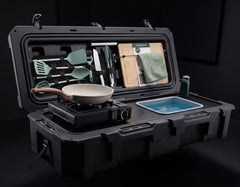
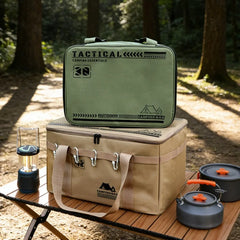
That's the whole argument for a self-contained box rather than a pile of separate gear. The VOZ Camp Kitchen packs the stove, sink, USB-rechargeable faucet, water tank, and the small stuff into one weatherproof case that opens into a working counter. For a pop-up owner specifically, the appeal is that it lives in the tow vehicle, not in the camper — so it doesn't eat cabinet space, doesn't need to be stowed before the roof drops, and doesn't add a fold-down step.


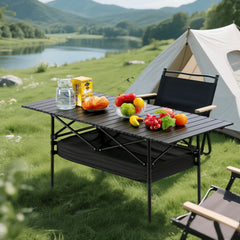
Two supporting pieces matter more than people expect. First, work height: a picnic table is a dining surface, not a counter, and cooking bent over one gets old by day three. A dedicated folding camp table at counter height solves it, and rolls up small enough to ride in the tow vehicle's cargo area.


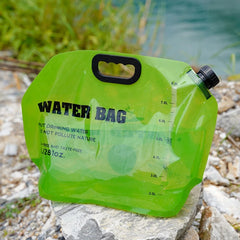
Second, water. If you've already decided not to trust the camper's 11-gallon tank, you need a real outside water plan — a jug with a spigot, or a pump that turns a standard bottle into a faucet. That's what makes an outdoor sink usable rather than decorative, and it means you're never dependent on plumbing you'd have to winterize.


Before You Unbolt Anything
Owners do remove galleys — threads on PopUpPortal walk through pulling the plumbing lines, unswinging the cabinet, and reclaiming the space for drawers or open storage. The reported payoff is storage volume plus a faster setup and teardown. But there are two cautions worth taking seriously before you reach for a drill:
- Structure. On many pop-ups the interior cabinets and seat boxes help support the outer walls. Removing a galley cabinet is not always a cosmetic change. Check whether there's independent framing behind it first.
- Resale. A camper with the factory galley intact is easier to sell than one with a hole where it used to be. The lower-risk move is to simply stop using the galley for a season and run the outside kitchen full time. If you don't miss it by October, then consider pulling it.
Most owners land in the middle: galley stays, gets used as dry storage and an extra flat surface, and every actual meal happens outside. That's a legitimate endpoint, not a failure to commit.
FAQ
Can I use my pop-up's galley stove outside?
On many models, yes — a number of pop-ups use a removable or slide-out stove designed to be mounted on the exterior rail. Check your owner's manual for whether yours is rated for outside mounting. The limitation is usually output and counter space, not the stove itself.
Does a camp kitchen box fit in a pop-up camper?
It generally shouldn't ride in one. Pop-up cargo capacity is limited and the interior is packed flat for travel. The better plan is to carry the box in the tow vehicle — an SUV cargo area or a truck bed — and set it up beside the camper on arrival.
Is it safe to cook inside a pop-up camper?
Using the factory-installed, vented galley range as the manufacturer intended is different from bringing a portable camp stove inside. Portable stoves, grills, and lanterns are not designed for enclosed spaces, and CPSC guidance is to keep them out of tents and similar enclosures because of carbon monoxide risk. Canvas walls do not make a space adequately ventilated.
Will cooking outside really save setup time?
It removes a step rather than adding one. On a swing-galley camper, the galley has to be returned to its travel position before the roof comes down. If it was never deployed, there's nothing to stow.
What about rain?
This is the honest weak point of outside cooking, and the fix is an awning or a canopy over the kitchen area rather than retreating inside. Most pop-ups have an awning rail already. Position the kitchen under it, and a weatherproof case means the gear itself doesn't care about the weather.
The Short Version
The pop-up galley is reasonable equipment fighting unreasonable constraints: no ventilation, permeable walls, a fold-down sequence, and campground rules that treat your camper as a tent. Owners cook outside because outside is where the space, the airflow, and — in bear country — the food already are. If you're cooking outside anyway, the upgrade isn't a better galley; it's a kitchen designed to live outdoors. The same logic plays out differently across trucks, vans, trailers, and RVs, but pop-ups make the case about as clearly as any platform can.
- Vehicle Camp Kitchen: Best Options for Trucks, Vans, Trailers & RVs
- Teardrop Trailer Galley vs. Portable Camp Kitchen: Do You Need Both?
- Camp Kitchen vs. RV Outdoor Kitchen: Do You Still Need a Portable Box?
- Camp Kitchen for Van Life: Built-In Galley vs. Portable Box
- How to Get Hot Water at Your Camp Kitchen Sink (Without an RV)
Ready to upgrade your camp kitchen?
The VOZ Camp Kitchen includes everything you need in one weatherproof case. Sets up in 15 seconds.
Shop VOZ Camp Kitchen →

