
Teardrop Trailer Galley vs. Portable Camp Kitchen: Do You Need Both?

The rear galley is the teardrop trailer's signature feature: lift the hatch and there's a kitchen — counter, cabinets, sometimes a sink — waiting exactly where you left it. But that kitchen is bolted to the back of your trailer, and that one fact shapes everything about how you cook at camp.
What a Teardrop Galley Does Well
A teardrop galley is the original grab-and-go kitchen. Everything rides pre-packed in cabinets and drawers, so there's no loading ritual before a trip and almost no setup when you arrive — you lift the hatch and start cooking. The open hatch doubles as a roof, giving you overhead shelter while you work, and the better builders lean into the concept hard. Timberleaf's Classic teardrop, for example, comes with a built-in stainless steel sink, a folding faucet, a dedicated stove slide-out, and a choice of 11-gallon or 17.5-gallon onboard water storage. Vistabule designs its galley with upper cabinets for spices and mugs plus a pass-through between the kitchenette and the cabin, so the cook can hand plates straight inside.
The whole package stays light, too. Teardrops generally run between 500 and 3,000 pounds, with a typical model landing around 1,500 pounds — light enough for small SUVs and many crossovers to tow. For a couple who camps out of the trailer on every trip and keeps meals simple, the galley alone can be a genuinely great kitchen.

Where the Galley Runs Out of Room
Cook out of one for a full season, though, and the same limitations show up in nearly every owner discussion:
- It cooks wherever the trailer parks. The galley faces whichever direction the campsite forces it to face. Back into a standard site and the hatch may open toward the road, into the afternoon sun, or straight into the wind. The trailer gets leveled for sleeping, not for cooking, and you can't slide the kitchen ten feet over to the shady side of camp.
- The counter is shallow. A teardrop galley compresses the entire kitchen into a space roughly the size of a dresser, so it works best as a one-cook station. Once someone is at the stove, prep work tends to migrate to the picnic table — if your site has one.
- Dishes still need somewhere to go. Galley sinks are small, and many basic or DIY galleys skip plumbing entirely. In practice, most teardrop campers end up setting up a separate table and washing dishes from a water jug carried in the tow vehicle.
- It stays home when the trailer does. Tent weekends, day trips to the lake, tailgates, a quick overnight where towing isn't worth it — the moment you leave the teardrop behind, you've also left your entire kitchen behind.
The Portable Camp Kitchen as a Galley Annex
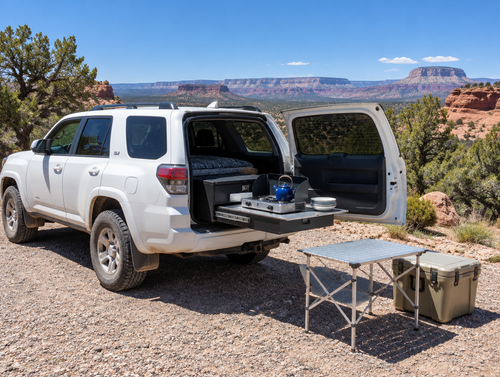
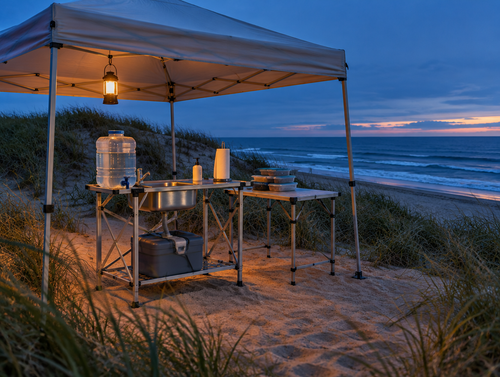
This is where a box-style portable camp kitchen earns its place, and it's the same logic teardrop specialists themselves recommend: an external folding kitchen station works as an annex to the galley, pulling prep and wash-up away from the cramped cooking zone. Unlike the galley, the box goes wherever you want it — the shady side of the site, next to the picnic table, upwind of the fire ring — and it stands at full working height on its own legs.
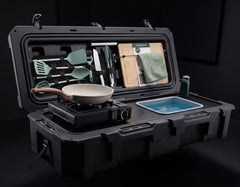
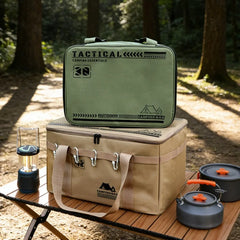
The VOZ Camp Kitchen takes the annex idea further than a bare folding table: the weatherproof case packs a built-in stove, a sink with a USB-rechargeable faucet, a water tank, and more than 30 pieces of cookware and utensils into one unit that unfolds in seconds. That means the annex isn't a second pile of loose bins to manage — it's a complete second kitchen with its own running water.


For families, the two-station layout changes dinner entirely. One person works the galley stove while another preps or washes at the box, instead of everyone queuing behind a single shallow counter. And the dish problem — the one nearly every teardrop owner improvises around — becomes a non-issue when the annex has its own sink and faucet. Pair it with the 3-bin dishwashing method and wash-up takes minutes.

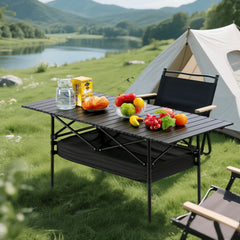
If your galley already handles cooking well and you only need overflow space, even a simple folding camp table fills the annex role for prep and drying racks — though it won't bring water or a stove to the party.


Galley vs. Portable Box: Side by Side
| Teardrop galley | Portable camp kitchen | |
|---|---|---|
| Location | Fixed at the trailer's rear | Anywhere in camp |
| Counter space | Shallow, one cook at a time | Full standing-height workstation |
| Water | Onboard tank on higher-end builds; jug-and-basin on basic ones | Built-in tank, sink, and rechargeable faucet |
| Setup | Lift the hatch | Unfold the case |
| Works without the trailer | No | Yes — tent trips, tailgates, day use |
| Cost | Built into a trailer that can run past $23,000 new | A small fraction of that |
So Do You Need Both? Three Honest Scenarios
Weekend couple, simple meals: probably not. If it's two of you, you cook at the trailer every time, and dinner is one pot and coffee, the galley plus a cutting board covers it. Spend your money on a good cooler instead.
Basecamp trips, families, and groups: yes. Multi-day stays are exactly where an external kitchen station shines — more burners, more counter, a real dish station, and two people cooking at once. The galley becomes the beverage-and-snack bar; the box does the heavy lifting.
Bear country and busy campgrounds: a latching case simplifies compliance. The National Park Service asks campers to stow stoves, grills, coolers, cooking utensils, and anything with food odors whenever they're not in immediate use — see the NPS food storage guidelines. Consolidating your entire cooking setup into one sealed box turns that into a single trip to the tow vehicle instead of a scavenger hunt across the campsite.
There's also the quieter fourth scenario: you camp without the trailer sometimes. The box rides in any cargo area, so your kitchen goes on every trip — teardrop or not. If you're still working out how a cooking setup fits your specific rig, our guide to vehicle camp kitchens for trucks, vans, trailers, and RVs maps the options across vehicle types.
FAQ
Can a portable camp kitchen replace a teardrop galley?
Functionally, yes — a box with its own stove, sink, and water tank cooks everything a galley cooks, and it does it anywhere. What it can't replace is the teardrop itself: the insulated cabin, the real mattress, the everything-always-packed convenience. If you already own the trailer, think of the box as an annex. If you don't, a portable kitchen plus your current vehicle delivers the cooking half of the teardrop experience for a small fraction of the price of a trailer.
Will a camp kitchen box fit in a teardrop tow vehicle?
Almost always. Teardrops are routinely towed by small SUVs and crossovers, and a folded camp kitchen case is sized for exactly that kind of cargo area. Since the teardrop carries your bedding and clothes, the tow vehicle's trunk is usually the emptiest space in the whole convoy.
Do teardrop galleys have running water?
Some do, some don't. Higher-end factory builds offer onboard tanks — Timberleaf's Classic can be ordered with 11 or 17.5 gallons of water storage and a stainless sink — while many entry-level and DIY galleys have no plumbing at all. If yours is in the second group, a portable kitchen with a built-in tank and rechargeable faucet is the fastest way to add running water to camp.
What about cooking in bad weather?
The open galley hatch sheds light rain and shade, but you're still standing outside, and wind-driven rain finds its way under any hatch. A portable box gives you the option to relocate — under an awning, a tarp, or a picnic shelter — which a bolted-on galley can never do.
- Vehicle Camp Kitchen: Best Options for Trucks, Vans, Trailers & RVs
- Camp Kitchen for Van Life: Built-In Galley vs. Portable Box
- Camp Kitchen vs. RV Outdoor Kitchen: Do You Still Need a Portable Box?
- Camp Kitchen Setup Time Compared: 15 Seconds vs. 10+ Minutes
- Camp Kitchen vs. Slide-Out Vehicle Kitchen: Which One Makes Sense for You?
Ready to upgrade your camp kitchen?
The VOZ Camp Kitchen includes everything you need in one weatherproof case. Sets up in 15 seconds.
Shop VOZ Camp Kitchen →