Running Your Camp Kitchen Off One Propane Tank: Trees, Hoses, and Adapters for Stove, Lantern, and Heater

Once a 20-lb tank is riding along, it makes sense to run more than the stove off it. A distribution tree or a set of hoses can feed the stove, the lantern, and a heater from one bottle, as long as you plumb it in the right order and set it up where nobody trips over it.
This guide is about the plumbing, not the fuel math. If you're still deciding how much propane to bring, read 1-lb canisters vs. a 20-lb tank first. Here we cover the hardware that splits one tank three ways: trees, hose manifolds, adapters, leak checks, and where the tank goes in relation to your kitchen box.
First, Know What the Tank Can and Can't Feed
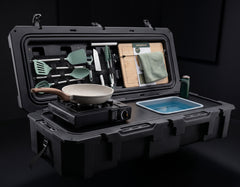
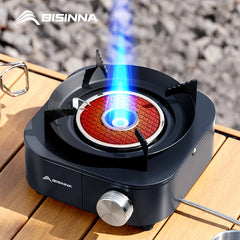
Start with an honest look at your box. Most all-in-one kitchens, including the VOZ Camp Kitchen, cook on a built-in butane stove that runs on its own canisters. A propane tree doesn't connect to that burner, and you shouldn't try to make it. The butane stove stays on its own canister and keeps working as the box's main burner.


The tank feeds the propane appliances that sit around the box. That usually means three things:
- A second, standalone propane stove on a side table for big pots, a griddle, or a second meal going at the same time.
- A propane lantern hung above the prep area.
- A portable propane heater for cold mornings around the cook station.
All three normally take a 1-lb green canister, and they connect through the same small-cylinder fitting, so a single bulk tank can replace a pile of disposables. Our 17,000 BTU 2-burner propane stove is a typical example: it runs on 1-lb cylinders or connects to a bulk tank through an adapter hose.


Distribution Tree vs. Hose Manifold
There are two ways to split one tank. Both work. They suit different campsites.
| Distribution tree (post) | Hose manifold (tee or Y + hoses) | |
|---|---|---|
| How it mounts | Screws into the tank valve and stands straight up from it | Small block at the tank valve with hoses running out |
| Outlets | Common retail trees have 3 small-cylinder outlets | Usually 2, sometimes 3 |
| Lantern | Hangs right on top of the post | Needs its own hose and a pole or hook |
| Footprint | Tank and lantern sit together in one spot | Tank can sit well away from the cook zone |
| Weak spot | Top-heavy on soft or uneven ground | More hose on the ground to trip over |
A tree mounts a short post on the tank and gives you several outlets. Popular 3-port trees use the standard CGA600 small-cylinder thread, the same one on a 1-lb canister, and each port has an automatic shut-off valve so an empty port doesn't vent. Some include an extension post, about 15 inches on one common model, to get the lantern higher. Even with the post, owners on overlanding forums often say the lantern sits lower than they'd like, so some run the lantern on its own hose and hang it higher.
A hose manifold skips the post. You put a tee or Y-splitter at the tank and run separate hoses to each appliance. Teardrop-trailer owners often prefer it because the tank can stay against a wheel or a tongue box while the hoses go where they're needed. Either way, every port needs its own hose to reach an appliance. Retail tree hoses come in lengths like 8 ft, so measure your layout before you buy.

Keep One Regulator in the Line
This is the rule that trips people up most often. Camp stoves, lanterns, and heaters built for 1-lb canisters almost always have their own regulator, the part right where the canister screws in. A tree or a plain adapter hose sends tank pressure straight to that regulator, and that is exactly how the system is supposed to work.
- Leave the appliance's regulator on. It's what turns tank pressure into the low, steady flow the burner needs. Never bypass it to "get more flame."
- Use a hose with no regulator between the tree and an appliance that already has one. Adapter-hose makers warn that a second regulator in the same line cuts gas flow twice, which can leave you with a weak flame or none at all.
- Check that hoses are rated for propane at the length you need. Buy the right length instead of chaining several short adapters together, because every extra joint is another place to leak.
- Heaters may need a filter. Portable heater makers strongly recommend an inline fuel filter between the heater's regulator and the hose any time the heater runs off a 20- to 40-lb tank, because hoses and bulk tanks can carry residue that 1-lb canisters don't. It isn't needed on a 1-lb bottle.
The appliance manual has the final word. If it names a particular hose or adapter, use that one.
Where the Tank Goes Next to the Box
A tree turns a 20-lb tank into a tall, top-heavy stand with a hot lantern on top. Where you put it matters as much as how you connect it. Our kit breakdown shows how much happens on and around the box: the sink, the faucet, and the prep surface. Keep the tank out of all of that.
- Keep the tank upright. A propane cylinder draws vapor from the space above the liquid. Fire-service training material warns that a cylinder lying on its side can leak liquid propane, which expands about 270 times as it turns to vapor. That makes a much bigger leak than vapor would.
- Put it on firm, level ground to the side of the cook zone, not behind you where you step back from the stove. Some trees have an adjustable base for uneven ground, but owners still report wobble on soft dirt.
- Route hoses away from foot traffic. Run them behind the table legs or along the box edge. Never run one across the path between the cooler and the sink.
- Keep hoses away from heat. Don't let a hose touch the underside of a hot stove, a burner grate, or the butane stove in the box.
- Secure it for the night. Shut the tank valve at bedtime, and the lantern on top goes out with it.


A tree lantern also isn't your only light. If you'd rather not have a hot glass globe above the prep area, an LED or USB light over the box does the same job without the heat. Our lighting guide in the reading list below compares the options.

The Leak Check, Every Time You Connect
A tree adds several more threaded joints: tank to tree, tree to each hose, and each hose to each appliance. Check all of them with soap, never with a flame, every time you put the system together.
- Mix dish soap and water in a spray bottle.
- With every appliance valve off, open the tank valve slowly so the lines fill with gas.
- Spray each joint: tank valve, tree base, every port, both ends of every hose.
- Watch for bubbles that grow or keep coming. Grill makers say a leak shows up as bubbles that form right away and get bigger.
- If you see bubbles, close the tank, tighten or remake that joint, and test again. If bubbles come from the tank itself, don't use or move it. Call your propane supplier or the fire department.
- Rinse the joints with plain water afterward. At least one grill maker notes that soap solution can be slightly corrosive to fittings.
Do the test outdoors, away from any lit burner. That includes the butane stove in the box, so test before you start the coffee. A Palm Beach County fire-rescue guide citing NFPA 1 tells operators of propane setups to leak-test every fitting from the tank to the appliance before use, which is a good habit at a campsite too.
Heater and Lantern Safety Around the Kitchen
A tree makes it tempting to run a hose into the tent or camper to a heater. Don't. The U.S. Consumer Product Safety Commission reports that people die every year from carbon monoxide poisoning caused by portable camping heaters, lanterns, or stoves used inside tents, campers, and vehicles. It advises against using portable heaters or lanterns while sleeping in enclosed spaces, especially at high altitude. Keep everything on the tree outdoors, by the kitchen, where it belongs.
When you pack up, close the tank valve first and let the lines burn off. Then disconnect the hoses and store the tank upright and secured in the vehicle. Don't put it inside the box. Small canisters have their own storage rules, covered in our fuel-storage guide below.
FAQ
Can a propane tree run the burner built into my camp kitchen box?
Usually not. Most box kitchens, ours included, use a butane burner, and a propane tree has no safe connection to it. Use the tree for a standalone propane stove, a lantern, and a heater, and keep the box's burner on its butane canister.
Do I need a regulator on the tree?
Not for typical 1-lb appliances. They already have a regulator where the canister would screw in, and the tree feeds that regulator. Adding a second one in the line can starve the flame.
Tree or hoses: which is better next to a kitchen box?
A tree is tidier when the lantern and stove are close to the tank. Hoses are better when you want the tank out of the cook zone, against a wheel or table leg, with nothing tall and wobbly beside you.
How often should I leak-test?
Every time you connect anything. Test after each setup, after swapping tanks, and after moving a hose. The soap test takes about a minute.
Ready to upgrade your camp kitchen?
The VOZ Camp Kitchen includes everything you need in one weatherproof case. Sets up in 15 seconds.
Shop VOZ Camp Kitchen →