Can You Store Propane Canisters Inside a Camp Kitchen Box? Fuel Storage and Hot-Car Transport

Yes — a 1-lb propane canister can ride inside a camp kitchen box, and at camp it's actually one of the better places to keep it. The one situation where the answer flips to a hard no: leaving canisters inside a closed vehicle parked in the summer sun. Here's the line between the two, with the actual temperature and pressure numbers.
The short answer
Fuel storage in a camp kitchen box comes down to one variable: heat.
- At the campsite: Fine. A closed box in the shade keeps canisters cooler, drier, and better protected than leaving them loose on the picnic table. Disconnect the canister from the stove first and store it upright.
- Driving to camp: Fine, with conditions. A climate-controlled cabin or cargo area with people in the car stays far below any danger threshold. Keep canisters upright and don't bury them under gear.
- Parked car in summer sun: No. This is the scenario every canister warning label is written for, and the numbers below show why.
- Between trips: Take the canisters out of the box. The packed box can live in the garage; the fuel should live somewhere shaded, ventilated, and away from the house's living space.
The 120°F rule: why heat is the whole problem
Propane cylinder manufacturers and propane suppliers converge on the same storage ceiling: don't let a cylinder exceed 120°F. That number isn't arbitrary. Propane is stored as a liquid under its own vapor pressure, and that pressure climbs fast with temperature. Published propane pressure charts put it at about 110 psi at 70°F, 177 psi at 100°F, and 204 psi at 110°F — nearly double the room-temperature figure before you even reach the warning threshold.
Cylinders are built with margin beyond 120°F — relief valves on standard propane cylinders are typically set around 375 psi — but that margin is your crash barrier, not your parking spot. When a cylinder overheats enough for the relief valve to open, it does its job by venting propane gas. Outdoors, that's a scare and a smell. Inside a closed vehicle or a sealed box, it's a flammable cloud pooling around your gear waiting for an ignition source. That venting behavior — not the cylinder bursting — is the realistic failure mode campers should plan around.

How hot does a parked car actually get?
Hotter than the 120°F ceiling, and faster than most people guess. Researchers at Arizona State University and UC San Diego measured vehicles parked in the sun on hot summer days: cabin air averaged 116°F after just one hour, while dashboards hit 157°F and seats 123°F. Parked in the shade, cabins still reached roughly 100°F.
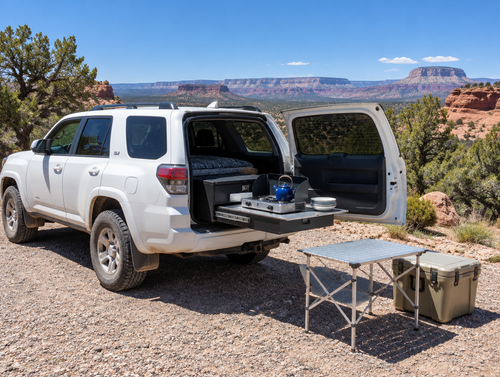
Read those numbers against the 120°F limit. One hour in the sun puts average cabin air within a few degrees of the ceiling — and that's the average, after only sixty minutes. A canister sitting in direct sun through glass, or in a dark-colored box absorbing radiant heat in the cargo area, is tracking closer to those surface temperatures than to the air temperature. A camp kitchen box's insulation-like mass slows heating during a lunch stop, but over an afternoon in a July parking lot the inside of the box catches up to the inside of the car. The rule that falls out of the data: canisters can drive with you, but they don't get left behind in a parked car on a hot day — and neither does a box with canisters in it.
Riding to camp: transporting canisters the smart way
While you're driving, the picture is friendly: the AC is on, air is circulating, and cabin temperatures sit in the 70s. Safety guidance for hauling propane in a passenger vehicle, which follows NFPA 58, adds a few rules worth keeping even for the small green cylinders:
- Upright, always. An upright cylinder keeps the relief valve in contact with vapor instead of liquid. If a valve ever vents, you want it releasing gas, not spraying liquid propane.
- Ventilated space, not a sealed trunk. A cargo area that shares air with the cabin beats a closed trunk with no airflow.
- Shaded from direct sun. Glass turns sunlight into radiant heat. A canister on the rear deck under the back window is the worst seat in the car; low in the cargo area, shaded by the box or a blanket, is the best.
- Know the legal ceiling. Guidance for enclosed passenger vehicles caps total propane at 90 pounds, with no single cylinder over 45 pounds. A car camper carrying two or three 1-lb canisters is nowhere near any limit — this is a heat problem, not a quantity problem.
- Don't leave it parked. Grocery stop, fine. All-day trailhead parking in August sun — take ten seconds and move the canisters out of the vehicle or at minimum out of any direct sun.
If you're still deciding what fuel to carry in the first place, our comparison of 1-lb canisters vs. a 20-lb tank for a camp kitchen covers the cost and runtime math; the transport rules above apply to both sizes, but a 20-lb tank should travel secured upright in an open bed or well-ventilated cargo area, never loose in a trunk.


Inside the box at camp: yes — here's the right way
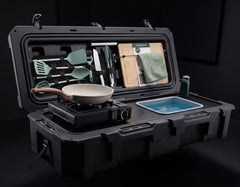
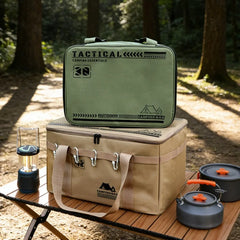
Once you're at the campsite, the box becomes the best fuel locker you have. The VOZ Camp Kitchen is a weatherproof case, which means canisters stored inside stay dry through overnight rain and dew, out of direct sun, and off the ground where they'd otherwise collect moisture and start rusting around the base. Rust and dents are the long-term enemies of a steel cylinder; a padded slot inside a hard case beats a canister rolling around a wet stuff sack every time. If you're mapping out where fuel fits among the rest of the gear, see what's included in a complete camp kitchen kit — a dedicated fuel spot is one of the details that separates a kitchen system from a bin of loose gear.


Three habits keep the box-as-fuel-locker setup clean:
- Disconnect before you close the lid. A canister left threaded onto a stove inside a closed box is the one configuration that can slowly leak fuel into a sealed space. Unscrew it after cooking — it takes five seconds.
- Store canisters upright, valve up, in their own corner of the box — not lying on their sides under cast iron.
- Put the box in shade. Under the table, on the shaded side of the vehicle, or under your canopy. Shade is worth roughly 16 degrees inside a parked car in the ASU/UCSD data, and the same physics applies to a box sitting in open sun all afternoon.

Between trips: the one place canisters should not live
Home storage is where most campers quietly break the rules. The packed camp kitchen box usually winters in a garage, an attic, or the back of the vehicle — and garages hit summer temperature spikes, attics blow well past 120°F, and a vehicle is the parked-car scenario on a 90-day timer. Best practice from propane suppliers is simple: cylinders live outdoors or in a detached, ventilated space — a shed, a covered porch corner — upright, shaded, and away from anything that makes sparks. Pull the canisters out of the box when you unpack, and the rest of your kit can be stored anywhere that's convenient; our guide to storing a camp kitchen between trips covers the box side of that routine.
Before each season, give every canister a ten-second inspection: heavy rust, dents, or a hissing sound at the valve means the cylinder gets retired — most hazardous-waste facilities and many propane retailers take old canisters.
FAQ
Can I leave the canister attached to the stove inside the box?
No. Disconnect after every cooking session. A threaded connection under constant pressure inside a sealed case is the one setup where a slow leak has nowhere to go. Every stove we carry — from single-burner cassette stoves to two-burner propane models — disconnects in seconds by design.
Is the trunk okay for the drive to camp?
A sealed trunk is the weakest option: no ventilation, no visibility, and often the hottest enclosed space in a parked car. Use the main cargo area or cabin floor instead, keep canisters upright and out of direct sun, and never leave them in the vehicle once it's parked in summer heat.
Do butane canisters follow the same rules?
Yes, and then some — butane cassette canisters carry the same heat warnings and the same disconnect-before-storing rule. The fuels behave differently at the other end of the thermometer, though: butane struggles in cold weather where propane keeps flowing. Our butane vs. propane camp stove guide breaks down when each fuel makes sense.
What if I smell gas or hear hissing from the box?
Open the lid, back away, and let it air out — no flames, no stove igniters, no cigarettes anywhere near it. Once the smell clears, check the canister valve and threads. A canister that keeps hissing gets carried to open air, away from camp, and retired.
Is cold storage a problem too?
Cold is a performance problem, not a safety one. Propane stays usable to well below zero — it boils at -44°F — so a canister in a cold garage or winter campsite is safe; it just delivers less pressure to the stove as temperatures drop. Heat is the direction that matters for safety.
Ready to upgrade your camp kitchen?
The VOZ Camp Kitchen includes everything you need in one weatherproof case. Sets up in 15 seconds.
Shop VOZ Camp Kitchen →