

Do You Need a Shelter Over Your Camp Kitchen? Tarps, Canopies, and Screen Rooms Compared

Sun at noon, rain at dinner, mosquitoes the minute the wind dies — the cook takes the weather in a way the rest of camp never does, because you can't stir a pot from inside your tent. This is an honest comparison of the three ways to put a roof over a camp kitchen — a rigged tarp, a pop-up canopy, and a screen room — with real numbers on weight and coverage, and the stove-safety rules that apply under every one of them.
First: Do You Actually Need a Shelter?
Not always. For a one-night stop with a dry forecast, a shelter is a chunk of setup time you'll never get back. The kitchen box itself doesn't need the roof — a weatherproof case shrugs off drizzle on the tailgate. The shelter is for the cook: your dry hands, your shaded prep surface, your ability to keep dinner going when the sky opens.
You'll want a roof when at least one of these is true:
- Base camp for two or more days. The setup cost amortizes over every meal.
- Rain in the forecast. Cooking in rain gear gets old exactly one meal in.
- Exposed sun. Desert and open-field sites cook the cook; midday shade turns the kitchen back into a place people want to stand.
- Bug country. Lakeshores and river bottoms at dusk make an unscreened kitchen miserable — and only one of the three shelters below solves this.
Placement does half the shelter's job for free: a site with afternoon tree shade and a natural windbreak may need no roof at all. Our guide on where to set up your camp kitchen covers how to read a site before you unpack a single pole.
Option 1: The Tarp — Cheapest, Lightest, Most Skill

A tarp is the classic backcountry kitchen roof, and it's still the value king. Figure a 10x10-foot tarp as the working minimum for a cook station, plus two to four poles, 20 to 50 feet of guyline, and a bag of stakes. A complete homemade rig runs about $50 in materials — a fraction of any framed shelter.
Two pitches cover most kitchen duty:
- A-frame ridgeline: a peaked center line between two anchor points, shedding water down both sides — the standard rain pitch.
- Slanted lean-to roof: one edge high, one low. Rain sheds off the low side, and the high side stays open for airflow and working light. This is the better cooking pitch because heat and steam escape the tall side.
Anchor guylines at roughly 45 degrees and the rig will take real wind — a low, tensioned tarp handles gusts better than any framed canopy. The trade-offs: it does nothing about bugs, it takes practice to pitch well, and a full rig can put ten-plus stakes and up to eight guylines around your cook zone — genuine trip hazards when someone's walking around with a hot pot.
Option 2: The Pop-Up Canopy — Instant Roof, Heavy Bag

The straight-leg pop-up canopy is what most car campers and tailgaters actually buy, and for good reason: a standard 10x10 model gives you 100 square feet of covered, full-height, vertical-walled space, and two people can have it standing in a few minutes with zero rigging knowledge.
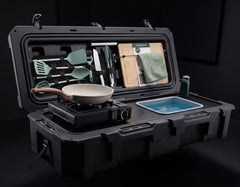
That 100 square feet comfortably covers an entire cook station. The VOZ Camp Kitchen is 47.6 inches long closed — open it on its stand under one half of the canopy and there's still room for a cooler, a trash line, and two people working without elbows touching. The box itself goes from packed to cooking in seconds, so the canopy becomes the only setup job of the evening — our step-by-step setup guide shows the whole sequence.


The costs are weight and wind. Framed 10x10 canopies run 40 to 80 pounds in the bag — a two-hand carry that eats a real slice of trunk space. And a canopy is the worst of the three shelters in gusts: the frame acts like a sail, and an unsecured one will fold or fly. Stake every leg, weight every leg, and drop it to its lowest height when the wind picks up. Sidewalls are sold for most models and are great for blocking low sun or sideways rain — but never zip on all four while a stove is burning. A fully walled canopy is an enclosed space, and enclosed spaces and camp stoves don't mix (more on that below).
Option 3: The Screen Room — the Only Bug Solution
If your kitchen problem is mosquitoes and flies rather than rain, mesh is the only real answer — no tarp or open canopy does anything after the wind dies at dusk. Screen shelters come in three broad builds, and the differences are mostly weight versus standing room:
- Hub-style screen houses with vertical sidewalls: around 32 pounds, low-90s square feet, fast setup, full standing headroom.
- Umbrella-style screen tents: 19 to 31 pounds with footprints from 108 to 144 square feet, though sloped sidewalls cut into usable standing space.
- Dome-style screen tents: the light option at 7 to 15 pounds, but the sloped walls shrink the zone where an adult can stand upright at a stove.
Shopping numbers that matter for a kitchen: look for 6 to 7 feet of clear standing height where the stove will sit, and around 7 feet at the peak so a lantern can hang without stealing headroom. If you want the shelter to cover a campground picnic table too, remember a typical table runs up to 96 by 30 inches — you need a footprint of at least 12 by 6.5 feet to fit it with walking room around the benches.
The catch: mesh stops bugs, not weather. Wind-driven rain blows straight through screen walls, so rain protection means buying a model with solid roll-down panels — and screen rooms with full panels closed run hot in summer and get treated as enclosed spaces the moment you close them up.
Side by Side: Tarp vs. Canopy vs. Screen Room
| Tarp | Pop-up canopy | Screen room | |
|---|---|---|---|
| Weight | Lightest — packs to a stuff sack | 40–80 lbs (framed 10x10) | 7–32 lbs by style |
| Covered area | ~100 sq ft from a 10x10, flexible | 100 sq ft (10x10) | 92–144 sq ft |
| Sun | Good — position beats the sun angle | Best — solid roof, add a sidewall | Good — most have solid roofs |
| Rain | Very good when pitched at an angle | Good — sides stay open | Poor through mesh; needs solid panels |
| Bugs | None | None without screen walls | Best — this is the reason to buy one |
| Wind | Best — low tensioned pitch sheds gusts | Worst — must be staked and weighted | Fair — guy out every point |
| Cooking airflow | Best — open on all sides | Good with two sides open | Good — mesh breathes, keep a door open |
| Best for | Backcountry, wind, tight budgets | Car camping, tailgates, base camps | Buggy lakeshores, dusk dinners |
Stove Safety Under Any Roof
Every one of these shelters changes one thing about your kitchen: it puts fabric and frame above and around a running burner. The U.S. Consumer Product Safety Commission's rule is blunt — never use a charcoal grill, hibachi, lantern, or portable camping stove inside a tent or camper, and CPSC counts roughly 20 deaths and 400 emergency-room injuries every year from carbon monoxide produced by charcoal grills alone (cpsc.gov). A shelter with all its walls closed is a tent as far as carbon monoxide is concerned, whatever the marketing calls it.
Working rules for cooking under cover:
- Two sides fully open, always. Open-sided shelter is the whole reason you can cook under one.
- Burner low and centered. Keep the flame well below the roof fabric and away from walls and guylines — heat rises in a column even when the flame looks small.
- Charcoal stays outside. Grills go beyond the drip line, full stop — a shelter roof concentrates both CO and rising heat.
- Know the symptoms. Headache, dizziness, weakness, or nausea while cooking under cover means shut the stove off and get to open air immediately.
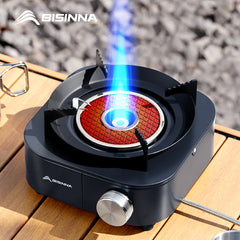
One more thing an open-sided shelter does not do: block wind at flame level. Gusts that roll under a tarp or canopy will still strip heat off a burner, which is why a stove with built-in wind protection — like a two-burner propane stove with a built-in windshield — pairs so well with an open pitch. We covered the full technique, including windbreak placement and flame management, in our guide to cooking in rain and wind.


FAQ
Can I cook under a pop-up canopy?
Yes, with conditions: at least two sides fully open, the burner low, centered, and clear of the frame and walls, and every leg staked or weighted. The moment all four sidewalls go on, it's an enclosed space — kill the stove.
Is it safe to cook inside a screen room?
Mesh walls pass far more air than solid ones, which helps. Keep the burner near an open doorway and well clear of the netting — mesh melts fast — and never cook with solid rain panels closed on all sides.
How tall should a kitchen shelter be?
Six to seven feet of clear height where you'll stand and cook, and around seven feet at the peak so a hung lantern doesn't cost you headroom. Sloped-wall designs list impressive floor sizes but shrink the zone where you can actually stand at a stove.
What size shelter covers a full camp kitchen?
A 10x10 footprint — 100 square feet — covers an all-in-one kitchen box on its stand, a cooler, and two people working. Add a standard picnic table (up to 96 by 30 inches) and you need at least 12 by 6.5 feet to keep walking room around the benches.
- How to Set Up a Camp Kitchen in Under 15 Seconds (Step-by-Step)
- Cooking With a Camp Kitchen in Rain and Wind: How to Weatherproof Your Setup
- Where to Set Up Your Camp Kitchen: Placement and Safety Rules That Actually Matter
- Are Camp Kitchen Boxes Waterproof? What Actually Happens When It Rains
- Beach Camping Camp Kitchen: A Cooking Setup That Beats Sand and Wind
Ready to upgrade your camp kitchen?
The VOZ Camp Kitchen includes everything you need in one weatherproof case. Sets up in 15 seconds.
Shop VOZ Camp Kitchen →

