Camp Kitchen With Wheels: When a Rolling Setup Beats a Carry Box

Wheels sound like the obvious fix for a 50-pound camp kitchen — until the pavement ends. Whether a rolling setup actually beats a carry box depends almost entirely on two things: what the ground between your vehicle and your cook site looks like, and how far apart they are.
What "Camp Kitchen With Wheels" Actually Means
Shop for a wheeled camp kitchen and you'll run into three very different animals wearing the same label:
- Rolling suitcase-style kitchens. Integrated boxes with two wheels and a telescoping handle, towed like airport luggage. VEVOR's Outdoor Mobile Kitchen is the best-known example: 40.8 pounds, a 65-liter storage box, and a fold-out stove, sink, and table surfaces that pack into one wheeled case rated to hold 80 pounds of gear.
- Patio-style rolling carts. Think Keter's Unity XL: a 50-pound resin cart on two caster wheels with a stainless-steel prep top and 78 gallons of combined storage. It rolls beautifully across a deck or driveway — but at 52.7 inches wide it's furniture, not luggage, and casters that glide on concrete stall in grass.
- A carry box riding on a separate wagon. The chuck box stays a box; a folding utility wagon does the rolling. This is the setup most car campers actually end up with, and we'll come back to why.
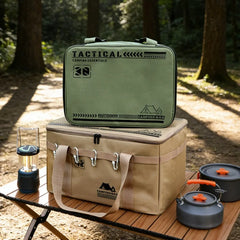
Notice what's missing: most dedicated camp kitchen boxes — the hard-sided, latch-shut kind covered in our complete chuck box guide — don't come with wheels at all. Even Camp Chef's Sherpa, a 13-pound camp organizer table that shows up in half the wheeled-kitchen search results, actually has carry handles and removable nylon bags, not wheels. The wheeled category is real, but it's smaller than the marketing suggests.
The Weight Math That Makes Wheels Tempting
Here's why people go looking for wheels in the first place. A fully loaded all-in-one kitchen — case, stove, sink, cookware, utensils — lands around 57 pounds with everything aboard. The NIOSH lifting equation, the standard ergonomists use for manual lifting, starts from a maximum recommended load of 51 pounds under ideal conditions: load close to the body, waist height, good grip, no twisting. Hauling a loaded kitchen out of a trunk and across a campsite violates most of those conditions at once.
Water makes it worse. At about 8.34 pounds per gallon, a full 2-gallon tank adds nearly 17 pounds on its own. A box that's a comfortable two-hand carry when dry becomes a deliberate, watch-your-step haul when tanked up. If you want the full breakdown of what these setups weigh empty versus loaded, our guide to real camp kitchen weights and the one-person carry runs the numbers model by model.
So the appeal is obvious: wheels turn a 57-pound lift into a pull. The question is whether they keep that promise on real ground.
Where Wheels Win: Pavement and Packed Ground

Rolling setups earn their keep anywhere the surface is hard and the haul is long:
- Tailgates and festivals. A stadium parking lot is the ideal habitat for a wheeled kitchen — smooth asphalt, long distances from the far corner of the lot to your spot, and multiple trips' worth of food and drinks. It's the same logic we cover in our tailgating camp kitchen guide: on pavement, rolling beats carrying every time.
- Developed campgrounds with paved pads. Many RV-oriented campgrounds have paved or hard-packed gravel pads where a wheeled box tows just fine for the last 30 feet.
- Walk-in sites with maintained paths. Some campgrounds put the parking area a short walk from the tent pad. If that path is packed dirt or crushed gravel, wheels convert several heavy carries into one easy pull.
- Backyard and patio duty. If your "camp kitchen" spends most of its life as an outdoor prep station at home, a caster-wheeled cart like the Keter genuinely makes more sense than a latching box built to survive a truck bed.
Where Wheels Lose: Sand, Soft Ground, and Rough Terrain
Off pavement, small wheels stop being transportation and start being decoration. Reviewers testing folding wagons consistently find that narrow wheels bog down in soft sand, and the same physics applies double to the small-diameter wheels on rolling kitchen boxes and coolers. Gear testers' rule of thumb for soft terrain is wide and tall — wheels around 7 inches tall and 4 inches wide with real tread are what it takes to keep rolling through sand, mud, and loose gravel. The hard little suitcase wheels on an integrated rolling kitchen are nowhere close to that spec.
There are quieter costs too:
- The mechanism is dead weight. Wheels, axles, and a telescoping handle add pounds and complexity you carry on every trip — including the trips where you park 10 feet from the picnic table and never extend the handle.
- More parts, more failure points. A latch and a hinge are easy to fix at camp. A bent axle or cracked wheel on an integrated box isn't, and it can make the whole kitchen miserable to move.
- Wheels dictate the box shape. Rolling kitchens need to be tall and narrow to tow well, which usually means less usable counter space when deployed than a wide, flat-lidded carry box.
- Uneven ground is their enemy at rest, too. A box on wheels wants to roll. On a sloped gravel pad, that's a pot of chili waiting to migrate.
Rolling Box vs. Carry Box vs. Box-on-Wagon
| Integrated rolling kitchen | Carry-style kitchen box | Carry box + folding wagon | |
|---|---|---|---|
| Best surface | Pavement, packed gravel | Any (you're the wheels) | Almost any, with big wagon wheels |
| Soft sand / rough trail | Poor — small hard wheels | Fine, but heavy | Good with 7-inch-class wide wheels |
| Weight character | Mechanism adds fixed weight | Lightest total system | Wagon adds ~26 lb, carried in the car, not on you |
| Hauls more than the kitchen? | No | No | Yes — cooler, water, firewood ride along |
| Failure points | Wheels, axle, handle | Latches, hinges | Wagon is replaceable separately |
The Setup Most Campers Should Actually Run
For most car campers, the answer isn't a kitchen with wheels bolted on — it's a good carry box plus a folding utility wagon when the site demands one. Folding wagons commonly carry 150 pounds, and heavy-duty all-terrain models are rated to 350 pounds or more, which means one wagon trip moves your entire kitchen, the cooler, and the water supply at once. When the site is right next to the car, the wagon stays folded in the trunk and costs you nothing.
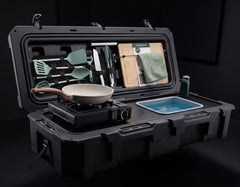
This is the logic behind the VOZ Camp Kitchen: it's built as a weatherproof carry case with a built-in stove, sink, USB-rechargeable faucet, water tank, and 30-plus cooking items in one box — a single deliberate carry at around 57 pounds loaded, or an effortless wagon ride when the tent pad is a hundred yards out. Because it's one consolidated case instead of a frame plus loose bins, it's also the piece of gear a wagon moves in a single trip.


Two practical tips if you go the wagon route: travel with the water tank empty and fill at the campground spigot — that's an instant 17-pound cut on a 2-gallon tank — and load the kitchen box flat on the wagon bed so the latches face up and nothing shifts on the bumps.
FAQ
Do any camp kitchen boxes come with built-in wheels?
A few do. VEVOR's rolling mobile kitchen is the most visible, with two wheels, a telescoping handle, and a 40.8-pound base weight. But the majority of hard-sided camp kitchen boxes are carry-style, because wheels add weight, cost, and failure points that only pay off on hard surfaces.
Is a wheeled camp kitchen good for the beach?
Generally no. Soft sand defeats small, narrow, hard wheels. If you cook on sand regularly, a carry box paired with a beach wagon running wide balloon-style tires is the proven combination — narrow wheels are the single most common complaint in soft-sand wagon testing.
Can I just add casters to my chuck box?
You can bolt casters to a plywood chuck box, and plenty of DIY builders do. Just know you inherit the same limits: casters roll on garage floors and pavement, not campsites, and they make the box want to wander on any slope. Locking casters help at rest but don't help in gravel.
What matters more — wheels or total weight?
Distance and surface decide it. Under 50 feet on any surface, weight matters more: one solid carry beats fiddling with a handle. Over 50 feet on pavement, wheels win. Over 50 feet on sand or rough ground, neither helps — that's wagon territory, and it's why the box-plus-wagon combo covers more situations than either a rolling kitchen or a bare carry box alone.
- The Complete Camp Kitchen Box & Chuck Box Guide
- How Much Does a Camp Kitchen Weigh? Real Numbers for a One-Person Carry
- Camp Kitchen for Tailgating: How to Cook Like a Pro in a Parking Lot
- Beach Camping Camp Kitchen: A Cooking Setup That Beats Sand and Wind
- Camp Kitchen Setup Time Compared: 15 Seconds vs. 10+ Minutes
Ready to upgrade your camp kitchen?
The VOZ Camp Kitchen includes everything you need in one weatherproof case. Sets up in 15 seconds.
Shop VOZ Camp Kitchen →