

Accessible Camp Kitchen: Setups for Wheelchair Users, Seated Cooking, and Campers Who Can't Lift a Heavy Box

Most camp kitchen advice assumes you can stand at a 36-inch counter and carry a loaded box from the truck to the picnic table. If you cook from a wheelchair or a camp chair, or lifting 50-plus pounds isn't happening, you need a setup built around a few different numbers, and most of them are already written into federal accessibility standards.
Start With the Numbers: Seated Work Height and Reach
The U.S. Access Board's ADA standards give a practical target for a seated work surface. Under section 902.3, accessible work surfaces sit between 28 and 34 inches above the floor or ground. Knee clearance under a surface is measured from 9 to 27 inches up, so a table you can roll under needs at least 27 inches of open space beneath it. For reaching, an unobstructed forward reach tops out at 48 inches and bottoms out at 15 inches.
The federal outdoor recreation guidelines carry the same logic outside. Under the Architectural Barriers Act standards, a cooking surface at an accessible campsite fire ring or grill sits 15 to 34 inches above the ground, and an accessible picnic table needs a wheelchair space at least 30 by 48 inches, set for a forward approach with knee and toe clearance underneath. Water spouts at hydrants land between 28 and 36 inches.
| Element | Federal guideline | What it means at camp |
|---|---|---|
| Work surface height | 28–34 in | Your target for the cutting board and sink deck |
| Knee clearance | Measured up to 27 in | Open space under a table for a forward roll-in |
| Forward reach range | 15–48 in | Keep the stove controls and faucet button inside it |
| Outdoor cooking surface | 15–34 in | The range campground grills are built to |
| Picnic table wheelchair space | 30 × 48 in minimum | The open spot you need beside your cook station |
These are building standards, not camping-gear ratings, but they're the best yardstick available. Compare that 28-to-34-inch window to the standing numbers in our camp kitchen counter height guide. A setup that works for a standing cook is usually 6 to 10 inches too high for a seated one.
Getting a Kitchen Box to Seated Counter Height
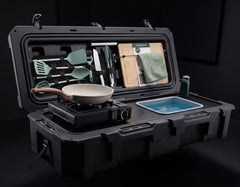
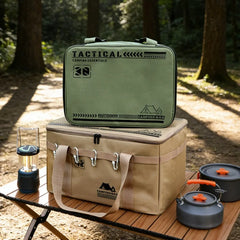
A camp kitchen box adds a fixed height to whatever it sits on. The VOZ Camp Kitchen is a 47.6 x 19.3 x 11.4-inch case with no legs of its own, so the work deck sits about 11.4 inches above the surface under it. That's the whole calculation: to put the deck somewhere between 28 and 34 inches, the base under the box has to be roughly 17 to 22 inches tall.


Here's how common bases work out:
| Base under the box | Base height | Approx. deck height | Seated fit |
|---|---|---|---|
| Ground | 0 in | ~11 in | Too low |
| Picnic table bench | 17–18 in | ~28.5–29.5 in | Inside the 28–34 in window |
| Low-set adjustable side table | Varies | Base + 11.4 in | Dial it in to your chair |
| Picnic table top | 28–32 in | ~39.5–43.5 in | Standing height only |
| Pickup tailgate | 28–34 in | ~39.5–45.5 in | Standing height only |
The picnic table bench is the surprise winner: its seat height puts the box deck right inside the seated range. Check that the bench is solid and wide enough for a 19.3-inch-deep case to sit flat without overhanging.
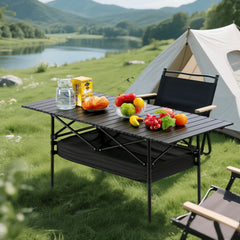
There's one trade-off to know. A box sitting on a solid bench leaves no knee clearance underneath, so you cook from the side rather than rolling under it, much like using a stovetop from a parallel position. For a lot of seated cooks that's fine for stirring and washing. For longer prep work, a separate table you can roll under, set between 28 and 34 inches with 27 inches of knee space, makes a good second station for the cutting board.

An adjustable-height table gives you the most control because you can set it to your chair instead of making your chair fit the table. Our adjustable-height folding camp side table goes from a low setting up to standing prep height, so it can serve as either the base for the box or a separate roll-under prep surface. Measure your own knee and armrest height before you commit to a setting.


Push-Button Water Instead of a Pump
Water access is where many camp kitchens quietly shut people out. A hand pump means repeated squeezing, a foot pump assumes you can push a pedal, and a gravity jug has to be lifted above the spout. For campers with limited grip strength or using one hand, each makes washing up harder.
A USB-rechargeable faucet replaces that work with a button. The VOZ kit's electric tap draws from a removable 2-gallon tank built into the case: press to start the flow, and both hands stay free to rinse a pan or wash up. The ADA operable-parts rule in section 309.4 is a helpful benchmark here. It calls for controls you can use with one hand, without tight grasping, pinching, or twisting the wrist, and with no more than 5 pounds of force. A camp faucet isn't certified to that standard, but a single press-to-run button sits much closer to it than a pump handle does. If you want to compare options, we put the main approaches side by side in our foot-pump sink station vs. camp kitchen sink comparison.
Practical tips for a seated setup:
- Keep the faucet button within reach. Before you start cooking, check that you can press it without leaning over a lit burner. On a box, that usually means facing the sink end, not the stove end.
- Charge the faucet at home. Topping it off before every trip means you never have to dig for a cable at camp.
Solving the Lift: Moving a Box Without Carrying It
A fully packed all-in-one kitchen weighs a lot. The VOZ case is about 57 pounds loaded, which already sits above the 51-pound starting point of the NIOSH lifting equation that ergonomists use, according to OSHA's guidance. That 51 pounds assumes ideal conditions, so for a lot of campers the realistic number is far lower. The answer isn't to get stronger. It's to stop lifting the full weight at all.
- Travel with the tank empty. Water weighs about 8.34 pounds per gallon, according to the U.S. Geological Survey, so a full 2-gallon tank adds nearly 17 pounds. Leaving it empty takes the loaded case down to about 40 pounds.
- Unpack in place. Leave the box in the vehicle or on its base and pull out the stove, pan, and utensils one at a time. Several 5-pound trips are easier than one 57-pound lift.
- Slide, don't lift. At a tailgate or bench, rest one edge of the box on the surface and pivot it into place, so you never take the whole weight at once.
- Pick a site where the kitchen can stay put. Choose a pull-through or a site where you can park next to the cooking area, so the box only moves a few feet.
- Get a hand for the two heavy moments. Loading at home and unloading at camp are the only real lifts; a two-person carry handles both.

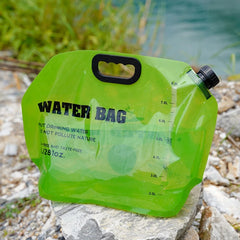
Filling the tank deserves its own plan. Rather than hauling a full jug, fill a smaller collapsible bag at the spigot and pour it into the tank in a couple of rounds, or fill the tank where it sits. A 2-gallon foldable camping water bag can be filled partway to keep each trip light.


Picking an Accessible Campsite for Your Kitchen
Your cooking setup only works as well as the ground around it. Federal outdoor guidelines call for a clear space of at least 36 inches around the usable sides of a picnic table, measured from the back edge of the benches, and 48 by 48 inches on the usable sides of fire rings and grills. Those clear spaces are just as useful around your camp kitchen box. Leave room to turn and pull up to both the stove side and the sink side.
When you book, look for sites marked as accessible. Individual campsite pages on Recreation.gov flag sites that are designated accessible, and the managing agency sets the reservation rules, so check the site details before you book. If you have a permanent disability, the free lifetime Access Pass, part of the America the Beautiful pass series, covers entry at federal recreation sites and typically gives a 50% discount on some camping fees, according to the National Park Service.
Firm, level ground matters for both your chair and the box, so pick a paved or compacted pad when you can.
FAQ
What height should a camp kitchen be for a wheelchair user?
Use the ADA work-surface range as a starting point: 28 to 34 inches from the ground to the top of the work surface. For forward roll-in access, the table also needs knee clearance measured up to 27 inches underneath. Your own chair, armrests, and reach will narrow that down, so test it at home before the trip.
Can I use a camp kitchen box if I can't lift 50 pounds?
Yes, if you plan around the lift. Travel with the water tank empty, unpack items one at a time while the box stays put, slide it instead of lifting it, and save the full-weight moves for when someone can help. Wheels or a cart also help on longer distances.
Is a push-button faucet easier than a hand pump?
For most people with limited grip or using one hand, yes. A single press starts the water and leaves both hands free, while a hand pump needs repeated squeezing. Check that the button sits within your reach range when the box is set up.
Can I cook seated on a regular picnic table?
The tabletop itself, at 28 to 32 inches, can work for a cutting board, but a kitchen box on top of it puts the stove and sink near 40 inches, which is standing height. Putting the box on the bench instead brings it down to about 29 inches.
The Bottom Line
An accessible camp kitchen comes down to three things: a deck between 28 and 34 inches, water that runs at the press of a button, and a plan that never asks you to lift the whole box alone. To compare these features across the category, see our guide to choosing the best camp kitchen in 2026.
Ready to upgrade your camp kitchen?
The VOZ Camp Kitchen includes everything you need in one weatherproof case. Sets up in 15 seconds.
Shop VOZ Camp Kitchen →

