Camp Kitchen Box vs. Camp Chef Explorer: Do You Need Counter Space or Just More Burners?

The Camp Chef Explorer is one of the most popular freestanding camp stoves sold in the US: two 30,000 BTU burners on legs, no table needed. The catch is the question owners keep asking right after they buy one: where do I chop, wash, and store everything else?
This isn't really a stove vs. stove comparison. A stove on legs and a camp kitchen box solve different problems. The Explorer gives you more fire. A box gives you a kitchen: counter space, a sink, storage, and running water. To compare them fairly, you have to price and pack the whole system on both sides. So that's what we'll do.
What the Camp Chef Explorer Actually Is
The Explorer (model EX60LW) is a two-burner propane stove with its own legs. Here's what the published specs and retailer listings agree on:
- Output: two cast-aluminum burners at 30,000 BTU/hr each, 60,000 BTU total.
- Cooking surface: 14" × 32", or 448 square inches.
- Cooking height: about 29" on most listings. Some retailers list 31".
- Weight: about 30.5 lb.
- Included: detachable legs that adjust for uneven ground, a three-sided windscreen, and a 3 ft hose and regulator.
- Fuel: propane, with the tank sold separately. Reviewers run it off a 20-lb tank.
- Accessories: it's part of Camp Chef's 14-inch cooking system, so it accepts their modular grill boxes, griddles, and pizza oven, all sold separately.
In CleverHiker's testing it boiled a liter of water in 6:59 and burned 3.2 oz of propane doing it, the highest fuel use in their guide. They scored it 4.3 out of 5 and listed it at $160. Their pros were the powerful flame, the wide cooking surface, the removable legs, and the fact that it stands on its own. Their cons were that it's bulky, heavy, awkward to pack, and needs a propane tank.
One line in that review sums up the whole debate. Because the stove is freestanding, it kept their camp table clear for prep. But with nothing built in around the burners, there was also "nowhere to set our spatula when cooking."

Concede the Obvious: The Explorer Wins on BTU
We're not going to pretend otherwise. 30,000 BTU per burner is a lot of heat for camping. In our camp stove BTU guide we found that around 10,000 BTU per burner covers what most campers cook: eggs, pancakes, burgers, and sautéed vegetables. Bigger groups do better at 15,000–20,000, and 20,000+ is for searing and very large crowds.
So the Explorer is overkill for a couple frying eggs, and exactly right for:
- Boiling a big stockpot for a crawfish or corn boil.
- Running a full-size griddle or grill box across both burners.
- Feeding a scout troop, a hunting camp, or a family reunion from one station.
- Cooking in wind, where a three-sided windscreen and spare power make up for lost heat.
The tradeoff is fuel. More heat burns more propane, and the Explorer's 3.2 oz per liter boiled is the cost of that output. You're also committed to hauling a bulk tank, which is its own decision. We cover that in 1-lb canisters vs. a 20-lb tank.
What the Explorer Doesn't Include: The Rest of the Kitchen
A stove is one station out of three. Every camp meal also needs a prep station and a wash station. The Explorer covers cooking well and leaves the other two to you. In practice, Explorer owners end up building a kit like this:
- A prep table for cutting boards, plates, and the spatula that has nowhere else to go.
- Storage bins for cookware, utensils, spices, and dry goods.
- A water jug and a wash basin, or a separate sink setup, for hand washing and dishes.
- A 20-lb propane tank and somewhere to keep it upright in the vehicle.
- Cookware and utensils, since the stove comes with none.
None of this is a knock on the Explorer. It's how the category works. A table-and-bins kitchen can cook very well. We compared that approach head to head in camp kitchen vs. folding table and bins. The real cost is setup time and the number of trips from the car.
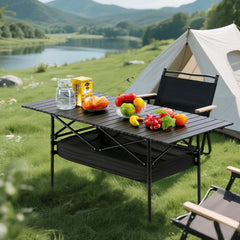
If you go the Explorer route, a solid table is the first thing to add. Look for one that holds weight without wobbling and stands close to the stove's roughly 29" cooking height, so prep and cooking sit at the same level.


The Box Approach: Counter, Sink, and Storage in One Case
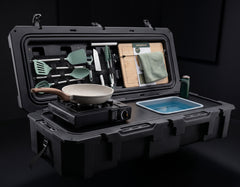
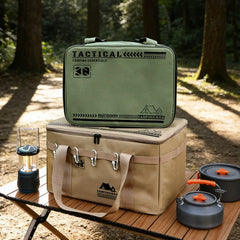
A camp kitchen box comes at the problem from the other end. Instead of a big stove plus everything else, you get one weatherproof case that already contains all three stations. The VOZ Camp Kitchen is our version. It comes with a built-in single-burner butane stove, a sink with a water tank, a USB-rechargeable faucet, and 30+ camping kitchen items in a weatherproof, dustproof, UV-resistant case. It sets up in under 15 seconds and weighs about 57 lb fully loaded.


Just looking at the scale, the box is heavier than the Explorer alone. But that 57 lb is the whole kitchen in one carry. The Explorer's 30.5 lb doesn't include the table, the bins, the water, the cookware, or the 20-lb tank. Add those up and the total weight is usually similar. You just move it in four or five trips instead of one.
This is the same split we described in our camp kitchen vs. chuck box guide. One approach has you assemble a kitchen at every campsite. The other has you open one. We ran a similar comparison against Camp Chef's soft organizer in camp kitchen box vs. Camp Chef Sherpa.

Side by Side: Explorer System vs. Kitchen Box
| Camp Chef Explorer + table + bins | Camp kitchen box (VOZ) | |
|---|---|---|
| Burners | 2 × 30,000 BTU propane | 1 butane burner built in |
| Cooking surface | 14" × 32" (448 sq in) | Single-burner platform |
| Prep counter | Separate table required | Built into the box |
| Sink and running water | Not included (jug + basin) | Sink, water tank, USB-rechargeable faucet |
| Storage | Separate bins | Weatherproof case holds 30+ items |
| Cookware and utensils | Bring your own | Included |
| Fuel | Propane tank (sold separately) | Standard butane canisters |
| Weight | About 30.5 lb stove only, plus everything else | About 57 lb, fully loaded |
| Setup | Legs, hose, tank, table, bins, water | Under 15 seconds |
| Best at | High-output, big-pot, big-group cooking | Complete, fast kitchen for couples, families, and small groups |
The Answer for Most Campers: Counter Space First, Burners Second
Here's the honest rule of thumb. If your camp meals regularly involve a 30-quart pot or a full-size griddle, you need burners, and the Explorer is a great tool for that job. If your meals are breakfast, a skillet dinner, coffee, and dishes for a family, the bottleneck isn't heat. It's having nowhere to cut onions and no running water to rinse the pan.
Many serious camp cooks end up with both. The box is the everyday kitchen: prep, wash, storage, and quick single-burner cooking. A high-output stove sits next to it for big-batch nights. If that's you, you don't need a 60,000 BTU unit to add a second station. A mid-range propane two-burner like our 17,000 BTU stove with windshield gives you a second and third burner without a bulk-tank-only setup, since it runs on 1-lb cylinders or connects to a bulk tank through an adapter hose.


A quick way to decide:
- Choose the Explorer system if you cook for big groups, boil or fry in large volumes, already own a good table and bins, and don't mind hauling a 20-lb tank.
- Choose a camp kitchen box if you want one carry, a sink with running water, built-in counter space, and setup in seconds for a family or small group.
- Choose both if you host big meals a few times a season but want a complete kitchen on every trip.
FAQ
Can I put a Camp Chef Explorer on top of a camp kitchen box?
We don't recommend it. The Explorer is designed to stand on its own legs at about 29", and its burners put out a lot of heat. Set it up next to the box on level ground, with its own clearance, and use the box for prep and washing.
Does the Explorer need a table at all?
Not for the stove itself, since it's freestanding. But you'll still want a table for prep, plates, and utensils. Reviewers noted there's nowhere on the stove to set a spatula down.
Is one butane burner enough for a family?
For most car-camping menus, yes. You cook one dish at a time, and the built-in sink and counter speed up everything around the stove. If you regularly cook two dishes at once, add a second stove next to the box.
Which is easier to pack?
The box. It's one weatherproof case. CleverHiker described the Explorer as bulky, heavy, and not easy to pack, and you still have to fit a table, bins, water, and a propane tank around it.
Ready to upgrade your camp kitchen?
The VOZ Camp Kitchen includes everything you need in one weatherproof case. Sets up in 15 seconds.
Shop VOZ Camp Kitchen →