

Camp Kitchen Box vs. Front Runner Wolf Pack Pro: One Box or a Stack of Boxes?

There are two honest ways to carry a kitchen in a vehicle: one case that opens into a cooking station, or a stack of identical boxes you pack however you like. Front Runner®'s Wolf Pack Pro is the default answer for the second approach — and it's worth knowing exactly what it does and doesn't do before you build a kitchen around it.
What a Wolf Pack Pro Actually Is
Start with the honest description: the Wolf Pack Pro is a storage box. Not a kitchen, not a table, not a system — a latching plastic crate engineered to survive being strapped to a roof rack or bounced down a washboard road. Front Runner lists it at $69.95 per box, and it has become close to the standard unit of measure in overland storage.
| Spec | Wolf Pack Pro |
|---|---|
| External dimensions | 20.1" L × 15.7" W × 9.1" H |
| Internal dimensions | 17.5" L × 13.2" W × 8" H |
| Capacity | 30 liters (about 8 gallons) |
| Empty weight | 8.1 lb |
| Material | Impact-resistant high-density polyethylene |
| Sealing | IP66 rated — dust-tight, resists strong water jets |
| Price | $69.95 per box |
Two details matter more than the rest. First, that IP66 rating is real and it's the reason the Pro exists: Front Runner replaced the original Wolf Pack's skinny plastic latches with wider sealing latches and added a reinforced honeycomb lid. Second — and this one catches people — the Pro does not nest with the original Wolf Pack. If you already own a stack of the old boxes, buying Pros means starting a second, incompatible stack.
The Stack Math: How Many Boxes Is a Kitchen?
The best real-world reference for this build style is the Overland Bound forum thread titled "The 2-Box (Front Runner) Camp Kitchen." The original poster splits it cleanly: one box for cooking — cookware set, utensils, propane, oils and soaps in bottles — and a second box for dinnerware, collapsible wash basins, mugs, cutting boards, and towels. It's a tidy, well-thought-out kit. And then comes the line that tells you everything: the camp stove is carried separately, and so is the Dutch oven.

Here's the geometry behind that. A Wolf Pack Pro's usable cavity is 17.5" × 13.2" × 8". A Coleman® Classic two-burner propane stove — probably the most common camp stove in America — folds down to roughly 21" × 13.5" × 5.6". It's about three and a half inches too long and a hair too wide. It is never going in that box, no matter how you angle it. Most full-size two-burner stoves have the same problem, because the boxes were designed around rack footprints, not around cookware.

So the realistic parts list for a Wolf Pack Pro camp kitchen looks like this:
- Box 1 — cookware, utensils, spices, fuel canisters
- Box 2 — dinnerware, wash basins, towels, cutting boards
- Box 3 (common, often a Hi-Lid) — dry pantry; the Hi-Lid kit adds 2.3 inches of height and runs about $80
- Stove — rides separately, outside the stack
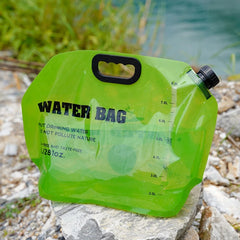
- Water — separately; a 5-gallon jug doesn't fit an 8-inch cavity
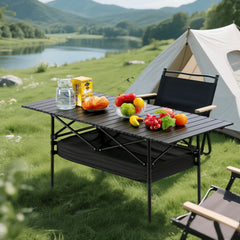
- A table — separately, because boxes don't have legs
What the Stack Genuinely Does Better
This isn't a straw-man comparison. There are real reasons the box stack has the following it does:
- Packing flexibility. Identical footprints Tetris into a cargo area or onto a rack in a way an irregular case never will. Two boxes wide, three high, done.
- Vehicle-agnostic. The same three boxes move from a truck bed to a wagon to a friend's rig in about a minute. Forum builders cite exactly this: they want a kitchen that works across two vehicles, so a built-in setup is off the table.
- Buy it a piece at a time. One box today, one in the spring. There's no $1,000 decision to make up front.
- Failure is cheap. Crack a latch on a dirt road and you're out $70, not a whole kitchen.
- Off-season duty. In November those same boxes hold recovery gear, tools, or your garage overflow.
If that list describes your actual problem — storage and transport, not cooking ergonomics — the stack is the right tool and you should stop reading. The same logic applies to the broader question of whether a dedicated box beats what you already own, which we worked through in camp kitchen box vs. plastic storage bins.
What You Don't Get: A Deployed Workstation
Three things a stack of boxes structurally cannot provide, no matter how well you pack it: a counter, a sink, and legs.
No counter. A Wolf Pack Pro lid sits 9.1 inches off the ground. Stack three and you're at roughly 27 inches — except you can't open the bottom two anymore, so it isn't a working surface, it's a closed pile. Front Runner's own answer to this is a separate product: the Pro Stainless Steel Prep Table, listed at $599 MSRP, 44.5" × 21.7" folded, 28.9" tall when opened, 22.1 lb. That's a good table. It's also nearly three-quarters of that boxes-plus-table budget, and it exists precisely because the boxes don't solve the surface problem. If you're wondering why that height number matters, counter height is the single most underrated spec in a camp kitchen.


No sink. Nothing in the stack moves water. You're carrying a jug, nesting two collapsible basins inside a box, and hand-pouring. That works, but it's a step you repeat after every meal, and it affects how you handle wastewater. The National Park Service's backcountry guidance is specific: strain food particles from wastewater, pack out the food scraps, and scatter the remaining water more than 200 feet from any stream channel. A basin you can lift and carry makes that easy. A puddle under the tailgate does not.


No legs, and three lids per meal. This is the part that only shows up after a few trips. Making dinner from a three-box stack means unstacking, opening, and re-latching all three boxes — then doing it again for cleanup, then again to repack. It's not hard. It's just friction, every single meal, and it's the reason people who camp a lot eventually go looking for something that deploys instead of something that stores. The related tradeoff between a loose kit and a purpose-built unit is the same one we mapped in camp kitchen vs. chuck box.
Cost, Weight, and Setup Compared
Here's what the two approaches actually add up to. Note carefully what's included in each column — that's where the comparison lives.
| Three Wolf Pack Pros + prep table | All-in-one camp kitchen case | |
|---|---|---|
| Hardware cost | $209.85 (3 boxes) + $599 table = $808.85 | $1,169 |
| Contents included | None — boxes ship empty | 30+ items: stove, pan, cutting board, knife, utensils, LED light |
| Empty hardware weight | 46.4 lb (24.3 lb boxes + 22.1 lb table) | About 57 lb fully loaded |
| Work surface | Separate purchase, 28.9" when opened | Built-in removable countertop |
| Sink and running water | None | Collapsible sink, USB-rechargeable faucet, 2-gallon tank |
| Stove | Separate, rides outside the stack | Built in |
| Setup per meal | Unstack, open 3 boxes, deploy table | Under 15 seconds |
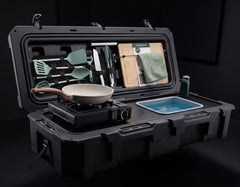
The $808.85 column buys you empty containers and a flat surface. Everything that turns it into a kitchen — stove, cookware, water, basins, lighting — is still ahead of you, and realistically adds several hundred dollars more. The VOZ Camp Kitchen comes at it from the other end: a 47.6" × 19.3" × 11.4" weatherproof case that opens into a countertop, a butane burner, a collapsible sink fed by a USB-rechargeable pump, a 2-gallon removable tank, and 30-plus pieces already in it.


FAQ
Will a two-burner camp stove fit inside a Wolf Pack Pro?
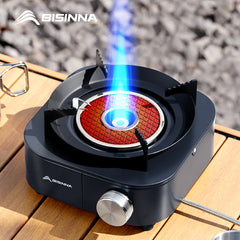
Almost certainly not. The Pro's internal length is 17.5 inches, and a Coleman Classic two-burner folds to about 21 inches on its long side. Full-size two-burner stoves are a bad fit across the board. Single-burner butane cassette stoves and compact folding burners are a different story — many of those will drop in fine.
How many Wolf Pack Pros do I need for a camp kitchen?
Two is the common minimum — one for cooking gear, one for dinnerware and wash-up. Three is more realistic once you add dry food. At $69.95 each, that's $139.90 to $209.85 in empty boxes, plus the stove, water, and table that live outside them.
Is the Wolf Pack Pro actually waterproof?
It's IP66 rated, which means dust-tight and sealed against strong water jets. That covers rain, road spray, and a dusty forest road. It is not a submersion rating, so don't treat it as a dry bag for a river crossing or leave it sitting in standing water.
Can I use the lid as a cutting board or a table?
The Pro's lid is embossed and honeycomb-reinforced rather than flat, so use a cutting board on top of it rather than cutting directly on it. And practically speaking, the lid is only usable as a surface when the box is closed — which means whatever is inside that box is unavailable while you're using it.
Do Wolf Pack Pros stack with the original Wolf Packs?
No. The Pro's redesigned lid and latch geometry means the two generations don't nest. Pick one generation and stay with it, or accept two separate stacks that won't lock together.
Which One Should You Actually Buy
Go with the Wolf Pack Pro stack if: you already run a Front Runner rack or a modular bed system, you shuttle gear between two or more vehicles, your cooking is genuinely simple, you want to spend incrementally, and you're comfortable owning a separate stove, separate water, and a separate table. You should also be someone who doesn't mind the per-meal unpack ritual — some people legitimately enjoy it.
Go with an all-in-one case if: you cook real meals at camp, you're tired of hunting through three boxes for the tongs, you want a counter and a sink without buying and carrying two more objects, or you're the person who does all the setup while everyone else is putting up tents. The comparison against a loose-gear approach plays out the same way whether the loose gear lives in premium boxes or in bins — the box quality changes the durability, not the workflow.
The Wolf Pack Pro is an excellent box. It is not a kitchen, and Front Runner has never claimed it is — that's why they also sell a $599 table. A stacked-box kitchen buys you packing flexibility, cross-vehicle portability, and a low entry price, and it costs you a deployed workstation: no counter, no sink, no legs, and three lids opened every time you want dinner. If storage is your problem, buy boxes. If cooking is your problem, buy something that opens into a place to cook.
- Camp Kitchen vs. Chuck Box: Complete 2026 Comparison Guide
- Camp Kitchen vs. Folding Table and Bins: Which Setup Actually Cooks Better?
- Best Portable Camp Kitchen for Overlanding: What to Look For
- Camp Kitchen Box vs. Snow Peak IGT: All-in-One Box or Modular System?
- All-in-One Camp Kitchen Box vs. Building a Setup Piece by Piece
Ready to upgrade your camp kitchen?
The VOZ Camp Kitchen includes everything you need in one weatherproof case. Sets up in 15 seconds.
Shop VOZ Camp Kitchen →

