Camp Kitchen for Music Festival Car Camping: Coachella, Bonnaroo & Beyond

A festival campground is the strangest place you will ever cook: a marked-off rectangle of dirt or asphalt, no picnic table, no water spigot at your site, and tens of thousands of neighbors a few feet away. Here is how to build a camp kitchen that actually works at Coachella, Bonnaroo, and any other car-camping festival — without getting your gear flagged at the search line.
Why a Festival Campground Breaks a Normal Camp Cooking Setup
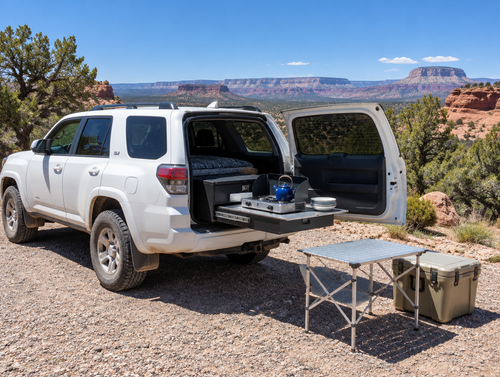
At a state park you get a picnic table, a fire ring, and usually a water spigot within a short walk. A festival campground gives you none of that. At Coachella, a car camping site is a 10-by-30-foot space, and your vehicle — which stays parked in that spot for the entire weekend — takes up most of it. Bonnaroo's general admission campsites run roughly 20 by 20 feet, and that footprint includes your car too. Everything you set up has to fit in the strip beside your vehicle, and everything you cook on has to be carried in, leveled, used, and packed away inside that strip.
Three festival-specific problems shape the whole setup:
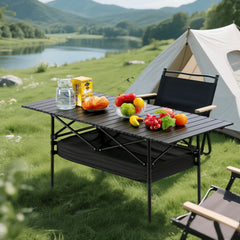
- No table. There is no flat surface unless you bring one — and Coachella's cooking rules require appliances to be tabletop devices placed on a flat, level surface. Cooking on the ground is not an option.
- No water at your site. Both festivals provide free water refill stations, but they are scattered around the campground, not at your spot. Every gallon you cook or wash with is a gallon somebody walked back to camp.
- No room to sprawl. The loose-bins-on-a-tarp system that spreads out fine at a quiet campground has nowhere to spread here. Compact, vertical, and self-contained wins.
Those are the same trade-offs we walk through in our guide to the best camp kitchen setup — a festival lot just pushes every one of them to the extreme.

Stove and Propane Rules: Coachella vs. Bonnaroo
Both festivals allow real cooking in their car camping areas, but the rules are specific and enforced when your vehicle is searched at the gate. The numbers below come from each festival's published camping rules — always re-check the current year's version before you pack.
| Rule | Coachella (Car Camping) | Bonnaroo (GA Camping) |
|---|---|---|
| Camp stoves | Allowed — maximum 2 burners per appliance, tabletop only, on a flat level surface | Allowed — grills and small camping stoves |
| Propane | Maximum 20 lb per campsite, or six 1-lb disposable cylinders | One container of 20 lb or less; the small 1-lb cylinders are limited to 2 per grill, per vehicle |
| Charcoal and open flame | Campfires and open flames are prohibited — propane is the way to go | Up to 40 lb of charcoal allowed for grills |
| When and how | Cooking allowed 7:00 AM–2:00 AM, never left unattended, with 3 feet of clearance around the appliance | Let grills cool completely before packing them into a trunk or tent |
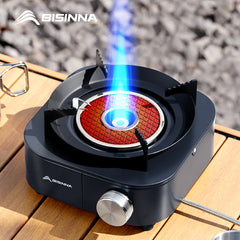
Notice where the ceiling sits: two burners. A compact folding two-burner propane stove lands exactly at Coachella's limit while giving you enough firepower to cook for a group — one burner for coffee water, one for the skillet. That is the stove class worth packing for any festival.


Why a Self-Contained Kitchen Box Beats Loose Bins in a Parking-Lot Campground
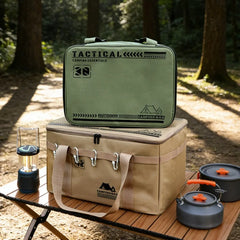
Festival veterans tend to arrive with three or four plastic totes: one for food, one for cookware, one for the stove, one for "kitchen stuff." By Saturday morning those totes are open on the ground, dusted over, and nobody remembers which one has the spatula. In a space where your entire kitchen, pantry, and dish station must fit in a strip beside the car, a single box that opens into a full workstation is a genuinely better tool.
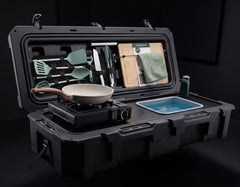
The VOZ Camp Kitchen is built around exactly this problem: one weatherproof case that unfolds into a cook station with a built-in stove, a sink with a USB-rechargeable faucet, a water tank, and 30-plus kitchen items already organized inside. It satisfies the tabletop-appliance requirement out of the box, it gives you the flat, level cooking surface festival fire rules demand, and when the desert wind kicks up dust across the lot, you close the lid and your kitchen is sealed instead of seasoned with grit.


If you have ever cooked a tailgate out of a hatchback, this is the same playbook. A festival is essentially a three-day tailgate — same asphalt, same no-table problem, same crowd — and the box-based approach we lay out in our tailgating camp kitchen guide transfers one-for-one.
Water: The Real Festival Bottleneck
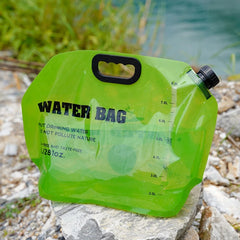
Ask anyone who has camped a festival what they underestimated and the answer is water. The refill stations are free, but they are a walk away, and lines form at peak hours. The move is to haul big and store smart: fill one or two large containers at off-peak times — early morning is best — and run your kitchen off stored water at your site.
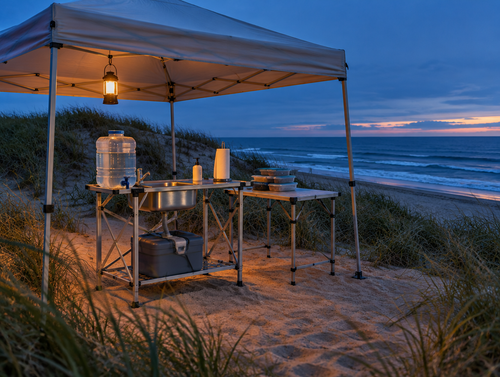
This is where a kitchen with a built-in tank and sink earns its footprint. Instead of tipping a jug over a pot every time you need to rinse a knife, you press a button on the faucet and wash with one hand while holding the pan with the other. Dishwater collects in the basin instead of turning the ground in front of your site to mud — and at a festival, where your "yard" is also your bedroom floor, that matters more than usual. A dedicated water container with a tap or an electric pump spout rounds out the system for drinking water.


The Festival Food-Price Math
Cooking at a festival is not just about comfort — the savings are real. At Coachella 2025, festivalgoers reported typical meals running about $15 to $30, with pizza slices at roughly $10 and lemonade at $17 a cup. Bring that home: two people replacing just breakfast and lunch with camp-cooked meals over three festival days is 12 meals. At that reported price range, those 12 meals would have cost $180 to $360 inside the venue — while a weekend of eggs, sandwich fixings, and pasta from a grocery run costs a fraction of that.
There is also a scheduling advantage nobody mentions: food lines inside the venue are longest right before headline sets. Eating a real dinner at camp means you walk in fed while everyone else is standing in line paying festival prices.
FAQ
Can I bring a camp kitchen box into Coachella car camping?
Yes — a camp kitchen box is treated like any other camping gear at the vehicle search. Keep the stove at two burners or fewer, keep propane within the posted limit, and remember that glass of any kind is prohibited, so decant sauces and drinks into plastic or metal containers before you leave home.
How much propane should I bring for a festival weekend?
Coachella allows up to six 1-lb disposable cylinders per campsite, and for most crews cooking two meals a day, that ceiling is more than a weekend actually burns. Bring the allowed maximum anyway; unused cans come home, but running dry on Sunday morning means paying festival prices for breakfast.
Where do I dump dishwater at a festival?
Never on the ground at your site — it turns the lot to mud and attracts flies to the whole row. Collect graywater in your sink basin or a lidded container and pour it out where the festival directs, typically at designated utility or shower-drain areas. The same principles from our graywater disposal guide apply, just with festival infrastructure instead of backcountry rules.
Can I cook at night after the shows?
At Coachella, yes — cooking appliances may be used from 7:00 AM to 2:00 AM, so a post-headliner quesadilla is fully legal. Keep the 3-foot clearance rule in mind even at 1:00 AM, and never leave a lit burner unattended while you wander off to a neighbor's site.
Ready to upgrade your camp kitchen?
The VOZ Camp Kitchen includes everything you need in one weatherproof case. Sets up in 15 seconds.
Shop VOZ Camp Kitchen →