

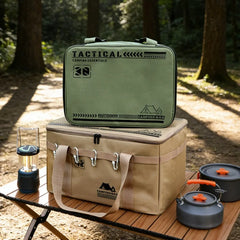
Carrying a Camp Kitchen on a Roof Rack: Weight, Weather, and Getting It Down Alone

Putting the camp kitchen on the roof looks like free space: the cargo area is full, the rack is empty, and the box is long and flat. But a loaded kitchen box is one of the heaviest single things you own for camping, and the roof is the hardest place on the vehicle to lift it to, the most exposed to weather, and the most expensive spot to carry it at highway speed.
Start With the Number That Actually Limits You: Dynamic Roof Load
Every roof has two load ratings, and people routinely read the wrong one. Dynamic load is what the roof and rack can safely carry while the vehicle is moving — it has to absorb braking, cornering, wind, and every pothole. Static load is what it holds while parked, and racks typically support three to five times their dynamic number when stationary. That static figure is why a roof can hold a rooftop tent with people sleeping in it; it says nothing about what you can drive with.
Dynamic limits are lower than most people expect. Many 4x4s and SUVs are rated somewhere between roughly 110 and 220 pounds (50–100 kg) while driving. One popular compact SUV's owner's manual caps the roof at 165 pounds — and that figure includes the crossbars themselves. Here's how a camp kitchen eats into that kind of budget:
| Item on the roof | Weight | Left of a 165 lb budget |
|---|---|---|
| Crossbar and tower set (example) | ~40 lb | ~125 lb |
| Loaded camp kitchen box | ~57 lb | ~68 lb |
| Same box with an empty water tank | ~40 lb | ~85 lb |
So yes, a 57-pound box fits under most dynamic ratings on paper. The catch is that the kitchen rarely rides alone — add a cargo bag, a recovery board, or a spare jerry can and you're at the limit fast. Always use the lowest number in the chain: vehicle roof rating, rack rating, or mounting hardware. And remember the rating assumes pavement. On washboard and rocky two-track, the bouncing multiplies the effective load on every mount, which is why overlanders treat the printed number as a ceiling, not a target.
What 57 Pounds Overhead Does to Your Lift
On the ground, a loaded kitchen box is a deliberate but reasonable one-person carry — we break down the math in how much a camp kitchen weighs and how to carry it. The NIOSH lifting equation starts from a 51-pound maximum under ideal conditions: load close to your body, around waist height, good grip, no twisting. A roof lift breaks every one of those conditions at once.
Ergonomists treat the zone above your shoulders as a "no-lift zone" for a reason: once a load goes above shoulder height, your core and stabilizer muscles lose leverage, your body mechanics change, and the risk of shoulder injury rises sharply. Now add that you're often standing on a door sill or a tire, reaching across the width of the vehicle, and pulling the box toward you rather than pushing it away. A 57-pound case that's an easy side-carry across camp becomes a genuinely risky lift above a mid-size SUV's roofline.
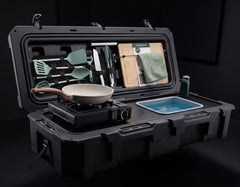
The shape helps a little and hurts a little. The VOZ Camp Kitchen packs into a long, flat 47.6 × 19.3 × 11.4 inch case, which lies low on a rack and spans crossbars well. But nearly four feet of length also means a long lever arm: if one end tips while you're sliding it off, you're suddenly holding most of the weight at arm's length.


Weather: The Roof Is the Worst Exposure Your Box Will Ever Get
A good molded case is built to sit out in the rain. That's different from riding through it at 70 mph. On the roof, the box takes direct sun all day, rain that the wind drives sideways into the lid seam and latch recesses, and road grit blasted at the hinge line. Inside a cabin or under a truck cap, none of that happens.
The VOZ case is one-piece food-grade LLDPE with stainless bar hinges and three latches, and it's weatherproof, dustproof, and UV-resistant with the lid closed. It is not a submersible dry box, and no camp kitchen is — our breakdown of whether camp kitchen boxes are waterproof explains the difference. If the kitchen has to ride on the roof in wet weather:
- Latch it fully, every time. A half-seated latch lets the lid flex open at speed, and that's where water gets in.
- Point the hinge side forward. The lid's opening edge then faces away from the oncoming wind and rain.
- Bag the electronics. The USB-rechargeable faucet pump has a charging port; give it a zip bag on rainy drives.
- Dry it out at camp. Open the lid and air everything out on the first dry afternoon so nothing sits packed damp.

Fuel Economy, Clearance, and Handling
Weight on the roof costs less than the drag it creates. According to fueleconomy.gov, a large, blunt roof-top cargo box can cut fuel economy by about 2–8% in city driving, 6–17% on the highway, and 10–25% at Interstate speeds of 65–75 mph. A camp kitchen box is smaller than a full cargo carrier, but it's the same kind of square-edged shape. By comparison, rear-mount boxes and hitch trays cost only 1–2% in the city and 1–5% on the highway — and the extra weight itself barely matters, since 100 pounds inside the vehicle trims mpg by roughly 1%.
Three more costs people forget:
- Height. Lying flat, the case adds about a foot on top of your rack. Know your new total height before the parking garage, the drive-thru canopy, or your own garage door teaches you.
- Center of gravity. Vehicle makers warn against heavy cargo on roof racks because SUVs already sit high, and every pound up top makes body roll and emergency swerves worse.
- Securement. A roof load sees more wind and vibration than anything inside. Strap it to the rack itself with two cam straps, never to the crossbar end caps, and re-check after the first few miles.
How to Get It Down Alone Without Hurting Yourself
If the box goes on the roof anyway, the safest technique is to never hold the full weight above your shoulders:
- Lighten it before it goes up. Travel with the 2-gallon tank empty — water weighs about 8.34 pounds per gallon per the USGS, so that alone drops the box from about 57 to about 40 pounds. Pull the heaviest loose items (cast iron, canned food, fuel) and ride them inside.
- Load from the rear, not the side. Slide the box lengthwise along the crossbars from the back of the vehicle. You push and pull along its length instead of lifting across the roof.
- Use a landing pad. Drop the tailgate or open the rear hatch and slide the box down onto it end-first. The roof-to-tailgate step is a short tilt, and the tailgate-to-ground step is a normal waist-height lift.
- Stand on something solid. A folding step or door-sill step beats balancing on a tire. Keep your feet square and your hips facing the box.
- Never pull it toward your face. If the box starts to slide faster than you expected, let it settle onto the rack or tailgate rather than catching it overhead.

The Honest Verdict: The Roof Is the Worst Place for Your Kitchen
A camp kitchen isn't a spare tire you'll touch once a trip. You open it for breakfast, lunch, and dinner, and every one of those meals starts with getting it down. That makes the roof the right spot for light, bulky gear you set up once — chairs, a tarp, sleeping pads, soft bags — and the wrong spot for a dense 40–57 pound box. The better swap almost always works: put the soft stuff on the roof in a weatherproof bag, and move the kitchen into the cargo area, the truck bed, or a hitch tray.


If you're working out where the box should live in your particular rig — truck, SUV, van, or trailer — our vehicle camp kitchen guide walks through each one.
FAQ
Can I put a camp kitchen box on a factory roof rack?
Often, yes, if the dynamic rating allows it after subtracting the crossbars and everything else on the roof. Check your owner's manual for the driving limit, not the parked one, and use the lowest rating in the chain.
Should I carry the water tank full on the roof?
No. A full 2-gallon tank adds about 17 pounds overhead, raising both the lift and the center of gravity. Fill it at camp.
Is a roof bag better than putting the kitchen box up there?
For the roof, yes. A soft bag full of light, bulky camping gear is easier to lift and frees cargo space for the heavy kitchen.
Will rain get into the box on the roof?
A latched, weatherproof molded case keeps out rain, but highway wind drives water into seams harder than a campsite storm. Fully seat every latch and bag anything with a charging port.
Ready to upgrade your camp kitchen?
The VOZ Camp Kitchen includes everything you need in one weatherproof case. Sets up in 15 seconds.
Shop VOZ Camp Kitchen →

