Camp Kitchen for Walk-In and Hike-In Tent Sites: How Far Can You Really Carry It?

Walk-in tent sites are the best value in car camping: more trees, more quiet, and usually fewer neighbors than the RV loop a hundred yards away. The catch is everything between your trunk and your tent pad, and a loaded camp kitchen box is the heaviest thing in that pile.
What "walk-in" actually means at a US campground
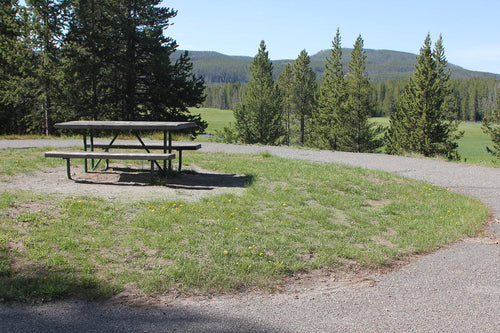
"Walk-in" is not a standard distance. It is a category that covers everything from a 50-foot stroll off a paved pull-in to a half-mile hike with a full cooler. The good news is that parks usually publish the number. The bad news is how wide the spread is.
| Park / campground | Published walk-in distance |
|---|---|
| Furnace Creek, Death Valley National Park (walk-to tent site) | 211 feet |
| Caprock Canyons State Park, TX | 10 to 30 yards from the parking area |
| Buescher State Park, TX (sites 61–65) | 10 to 60 yards from the parking lot |
| Fort Flagler State Park, WA | Within 100 yards of parking |
| Larrabee State Park, WA | Within 1/4 mile of parking |
| Battle Ground Lake State Park, WA | 1/4 to 1/2 mile from parking |
| Obstruction Pass State Park, WA | Just over 1/2 mile from parking |
| Minnesota state parks (walk-in and cart-in) | A half mile or less from parking |
Two of those numbers are worth memorizing as anchors. A 211-foot walk-to site is a non-issue: carry the kitchen box, go back for the cooler, done. A quarter mile is 1,320 feet, and at the 3.5 feet per second the Federal Highway Administration uses to time crosswalk signals, that is roughly six minutes each way — unloaded, on flat pavement. Four round trips at that distance eats most of an hour before you have set anything up.
So the first move is not a gear decision: book the site, then find the distance on the park's campground page or reservation listing. Everything below depends on that number.

The weight you are actually carrying
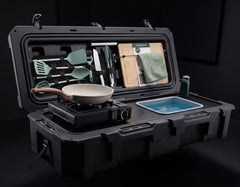
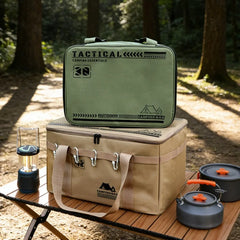
A full camp kitchen box is the anchor in the load. The VOZ Camp Kitchen weighs about 57 pounds with its 30-plus pieces inside, packs down to roughly 48 x 19 x 11 inches, and carries on two integrated handles. That is a comfortable two-person carry and a borderline one-person carry.
Borderline is the honest word. NIOSH's revised lifting equation starts from a load constant of 51 pounds — the most that nearly all healthy adults can lift with two hands under ideal conditions, meaning close to the body, knuckle height, good grip, no twisting. Every real-world variable in the equation only subtracts from that number, and reaching into a trunk to swing a 48-inch case out sideways is about as far from ideal as lifting gets. Our full breakdown of what a camp kitchen weighs and how to carry it goes deeper on the lifting mechanics.
Then there is water, which is where most walk-in plans quietly fall apart. The USGS uses about 8.34 pounds per gallon, so filling a 2-gallon tank at home turns a 57-pound carry into a 74-pound one. Carry the box dry. Always.


Distance lies — grade, surface, and stairs decide the carry
Olympic National Park's listing for Fairholme Campground warns that the trails leading to its walk-in sites are "relatively short and steep." Short and steep will wreck a carry faster than long and flat, and almost nobody checks for it in advance.
The federal accessibility standards for outdoor developed areas give a useful yardstick for how steep a legitimate campground route can be. An outdoor recreation access route can run any length at up to 1:20 (5 percent), but only 50 feet at a time between 1:20 and 1:12 (8.33 percent), only 30 feet at a time between 1:12 and 1:10, and never steeper than 1:10. In other words, a fully compliant route can still string together repeated 8 percent pitches. Push a wagon with 70 pounds on it up one of those and you will understand the difference between a distance and a grade.
Things that matter more than raw yardage:
- Steps. Any staircase ends the wagon conversation. It is hands and handles from there.
- Soft surfaces. Pine duff, loose gravel, and sand swallow small hard wheels. Pneumatic tires keep rolling.
- Roots and water bars. A 2-inch lip stops a 4-inch wheel cold.
- Trail width. A 48-inch case does not turn corners on 24-inch single track the way it does in a parking lot.
- Nowhere to set it down. On a sidehill with no flat spot, you carry the whole way or you drop it.
Walk the route empty before you unload anything. It takes two minutes, and it changes the plan more often than not.

Your carry plan, by distance
| Distance from parking | The plan |
|---|---|
| Under 75 yards, level | Carry everything as-is. Kitchen box one trip, cooler the next, sleep gear the third. Fill water at the site. |
| 75 to 200 yards | Two people on the box handles, one trip. Everything else goes in duffels and bins, never loose armloads. |
| About 1/4 mile | Wagon or a park-supplied cart if the surface allows it. If not, plan two staged loads and budget 30 to 40 minutes for the haul alone. |
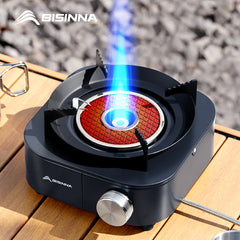
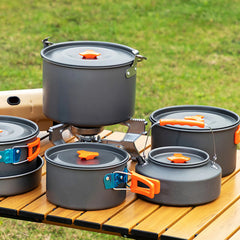
| Over 1/2 mile, or any steps or sand | Leave the full box in the vehicle. Pull out the stove, a nesting pot set, a collapsible jug, and one bin, and treat it like a light backpacking kitchen. |
The other half of the plan is what does not come. A walk-in site is the one time it pays to be ruthless about the car being your pantry, not your kitchen. Leave behind the 20-pound propane tank (bring 1-pound canisters or butane cartridges instead), every container of water, the backup cookware you will not touch in two nights, and the hard-sided rolling cooler you would have to drag over roots. A soft insulated cooler bag carries on a shoulder and leaves a hand free for the box handle.


Carts, wagons, and what the park already provides
Some parks have already solved this for you. Minnesota's DNR describes walk-in and cart-in sites as a half mile or less from parking and notes that at cart-in sites, visitors can use provided carts to move gear from the parking area to a campsite. Frontenac State Park stages its carts at the lot and runs about a quarter mile of paved trail to the sites. Ridgway State Park in Colorado parks wheelbarrows at the walk-in tent section of Loop H. If the listing says "cart-in" rather than "walk-in," you have effectively been handed a wheelbarrow.
If you bring your own wagon, two things decide whether it helps:
- Wheel diameter beats capacity rating. A wagon rated for 150 pounds with 5-inch plastic wheels is useless on roots. Large pneumatic tires roll over what small hard wheels stop against.
- Strap the box across the bed, not lengthwise. A 48-inch case balanced end-to-end on a 36-inch wagon becomes a lever every time a wheel drops into a rut.
If walk-in sites are becoming your default, the rolling-versus-carrying tradeoff deserves a real look — we compared wheeled camp kitchens against carry boxes across surfaces and terrain.
Water, bear lockers, and where the box actually lives
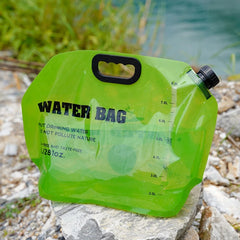
At a walk-in site, water is the recurring cost. Two gallons is about 16.7 pounds, a 2.6-gallon jug is roughly 22 pounds full, and a 3.4-gallon container is about 28 pounds. If the nearest spigot is back at the parking lot, that is a dedicated round trip every day or two, which is exactly the trip to put on the wagon. Sizing the tank to the trip matters more here than anywhere else, and we walked through the math in our guide to how many gallons a camp kitchen actually needs.


Then there is the storage question nobody anticipates. In bear country, the campground's food locker is not optional. Yosemite provides lockers at its campgrounds measuring 35 inches deep, 43 inches wide, and 28 inches high, and requires ice chests, food, drinks, and toiletries to be stored inside them. Look at that width again: 43 inches. A camp kitchen case that packs out to 48 inches long does not lay flat in that locker. Unload the food, drinks, and scented items into the locker and leave the emptied case at the site under a tarp — and confirm first, because Olympic's Fairholme listing notes that not all of its walk-in sites have a food storage locker.
FAQ
Can one person carry a full camp kitchen box to a walk-in site?
Usually, over short distances. A roughly 57-pound box is above NIOSH's 51-pound load constant for an ideal two-handed lift, and lifting it out of a trunk is not an ideal lift. Under about 75 yards on level ground, most adults handle it in one go. Past that, split the load: pull the interior kit into a duffel and carry the empty case separately, or put two people on the handles.
Should I fill the water tank at the car or at the site?
At the site, essentially always. Two gallons adds about 16.7 pounds to a carry that is already heavy, and the walk does not get shorter. The only exception is a site with no potable water nearby, in which case the water gets its own trip with a jug or a cart, not a ride inside the kitchen box.
Are wagons and carts allowed at walk-in campsites?
Generally yes. Walk-in sites restrict vehicles, not gear, and several state park systems hand out carts at the trailhead specifically for this. The limiting factor is almost always the trail surface rather than a rule. Check the park page if the route uses a shared hiking trail with posted restrictions.
How far is too far for a full camp kitchen box?
The practical ceiling is about a quarter mile on a packed, rollable surface, or roughly 150 to 200 yards if you are carrying by hand. Add steps, deep sand, or a sustained 8 percent grade and that ceiling drops fast. Past a half mile, stop trying to move the whole box and move a stripped-down kitchen instead.
What is the single biggest mistake people make on a walk-in carry?
Making trips with loose items in their arms. Every load should be a sealed bin, a duffel, or a box with handles. Loose gear turns a three-trip carry into a seven-trip carry. A planned setup — the kind we outline in our best camp kitchen setup guide — is mostly a packing decision made before you leave home.
Ready to upgrade your camp kitchen?
The VOZ Camp Kitchen includes everything you need in one weatherproof case. Sets up in 15 seconds.
Shop VOZ Camp Kitchen →