Camp Kitchen With an Oven: Can You Bake at Camp, and Where Does the Oven Go?

Yes, you can bake at camp with a kitchen box. The box itself won't have an oven inside, so the real question is which oven you add and where it goes: on the stove, beside it, or on a power station off to one side.
Does a camp kitchen box come with an oven?
Almost never. Most all-in-one kitchen boxes are built around a stovetop, a sink, a water supply, and storage. A few concept designs have tried to fit everything in: New Atlas covered the Space Box, a Kickstarter kitchen about the size of a large cooler that combined an oven, a two-burner stovetop, prep surfaces, and a sink. That kind of unit is rare. For nearly everyone else, baking means adding an oven to the kitchen you already have.
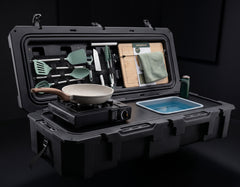
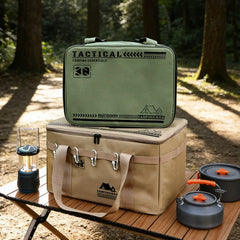
The VOZ Camp Kitchen is a typical example. It ships with a built-in butane stove and frypan, a foldable sink with a USB-rechargeable faucet, a removable 2-gallon water tank, and more than 30 cooking items in a weatherproof case. There's no oven compartment. That's on purpose, because an oven is the bulkiest, hottest, least-used piece of camp cooking gear, and most people only bake on some trips. For the full list of what's in a box like this, see our breakdown of what's included in a camp kitchen kit.


The four ways to bake with a kitchen box
Every camp oven falls into one of four types. What sets them apart is where the heat comes from, so that's what decides where the oven sits relative to your box.
| Oven type | Heat source | Where it sits | Works on a butane cassette burner? |
|---|---|---|---|
| Folding box oven (e.g. Coleman Camp Oven) | Your stove's burner | On top of a separate propane stove | No, it covers too much of the stove |
| Ring-style stovetop oven (e.g. Omnia) | Your stove's burner | On one burner | Only if it fits inside the grate |
| Cast-iron Dutch oven | Charcoal briquettes | On the ground, away from the box | Not applicable |
| Stove-and-oven combo (e.g. Camp Chef Outdoor Oven) | Its own propane burners | On its own, next to the box | Not applicable |
| Electric countertop oven | Power station | On a side table | Not applicable |
Stovetop ovens: the box oven and the Omnia
A folding box oven is a hollow metal box that sits over a burner and traps heat around a rack. The Coleman Camp Oven is the best-known example. It's aluminized steel, folds to about 13.5 x 12.9 x 3.3 inches, weighs around 7 to 8 pounds depending on the listing, and comes with a thermometer and a rack you can set at three heights. Coleman says it's designed to sit on top of Coleman propane and liquid-fuel camp stoves. That's the key detail: it's made for a full-size two-burner propane stove, not a compact burner.
A ring-style stovetop oven like the Omnia works differently. It has a steel base with a hole in the middle, an aluminum pan shaped like a ring cake mold, and a vented lid. Flame heat rises through the center hole and circulates down over the food. The standard model is about 250 mm (roughly 9.8 inches) across, holds about 2 liters, and weighs about half a kilogram. Because it sits on one burner and nests flat, it's the stovetop oven that fits a kitchen-box lifestyle best. Omnia says it works on gas and open flame but not on induction.

If you plan to use a box oven, the easiest setup is a separate two-burner propane stove beside your kitchen box. One burner runs the oven while the box's own stove handles the frypan or kettle. A windscreen makes a big difference, because wind pulls heat out of a thin-walled oven fast. Our 17,000 BTU 2-Burner Propane Camp Stove with Windshield is the type of stove these ovens are designed around. Measure its grate against your oven's footprint before your first trip. For the full dimensions check, see will your stove fit a camp kitchen box.


The butane warning nobody puts on the box
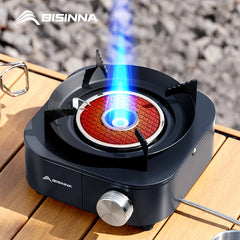
Most built-in kitchen-box stoves, the VOZ included, are butane cassette designs, with the fuel canister sitting right beside the burner. That changes what you can put on them. Health Canada cautions that pots and pans should fit the stove's cooking grate so they don't cover the gas canister, because a canister that overheats can explode or vent gas that then ignites. Product-safety regulators in Australia and Singapore give the same warning: an oversized pan reflects heat back onto the cartridge.
A folding box oven is wider than any pan you'd use on that stove, and it's built to trap heat. Putting one on a cassette burner is exactly what those warnings describe. Our rules for butane kitchen-box stoves:
- Never put a folding box oven on a cassette stove. Put it on a separate propane stove.
- Only use a ring oven like the Omnia if its base fits inside the grate and doesn't hang over the canister compartment. If it hangs over, don't use it.
- Keep baking heat moderate and check the canister by hand now and then. If the housing is too hot to touch, turn the stove off.
- Follow the maximum pan size in your stove's manual. It overrides anything you read online, including this article.
If you'd rather not have fuel and an oven that close together, the next three options keep the oven away from the box entirely. For more on how cassette fuel compares, see our guide to butane vs. propane for your camp kitchen stove.
Dutch ovens and combo ovens: bake next to the box, not on it
A cast-iron Dutch oven is the oldest camp oven and the one that has nothing to do with your stove. You heat it with charcoal briquettes on the ground, with coals on the lid and underneath. A common starting point is to double the oven's diameter for the briquette count, so about 24 coals for a 12-inch oven at roughly 325 to 350°F. Scout Life's chart puts about 17 coals on top and 8 underneath for that size. The Missouri Department of Conservation has a good Dutch oven cooking primer if you've never done it.
For a kitchen box, the important part is where you set it up. Coals belong on bare dirt, gravel, or a fire pan, well away from the case, the water tank, and any fuel. Set up your Dutch oven station a few feet to the side, off the edge of your prep area, so nobody has to reach over hot coals to get to the sink. A lid lifter and heat-resistant gloves come with the Dutch oven, not with the box, so pack them separately. Before lighting charcoal, check fire restrictions. Many restriction stages ban charcoal even when pressurized gas stoves are still allowed.

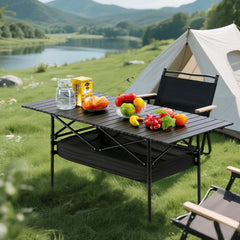
A stove-and-oven combo like the Camp Chef Outdoor Oven is the closest thing to a home range. Camp Chef lists the original model with two 7,500 BTU burners on top and a 3,000 BTU oven that reaches about 400°F. The oven is 11 x 16 x 9 inches inside, big enough for a 9 x 13 pan, and the whole unit is 12.5 x 21 x 18 inches. The tradeoff is size: at over 30 pounds and the footprint of a second appliance, it doesn't go on or in a kitchen box. It stands next to it on a table. If you bake on every trip, that's a fair trade. A sturdy table like our Quick Set-Up MDF Folding Camp Table gives it a level base away from the case.


Electric ovens from a power station
A small countertop oven plugged into a portable power station is the cleanest option, with no flame and no fuel near the box. The catch is power. Countertop ovens typically draw around 1,500 watts, and that's the steady load your power station's inverter has to handle. Some guides warn that 1,200 to 1,800 W resistive loads like toasters and kettles won't run on a 1,000 W station at all. Battery capacity decides how long you can bake. One power-station maker estimates about 0.8 hours of continuous running for a 1,500 W toaster oven on its 1,800 W unit. In practice the heating element cycles on and off once the oven reaches temperature, so a real bake usually uses less than the full rating, but plan around the worst case.
Put the oven on its own side table, not on the closed kitchen box lid, so the vents and hot top aren't against the case, and keep the power cord clear of the sink and water tank. If you're thinking about running your whole kitchen on electricity, the propane vs. induction guide linked below goes deeper on the battery math.
Heat clearance: protecting the kitchen box itself
Whatever oven you pick, the kitchen box itself needs protecting. A bake puts out steady heat from all sides for far longer than a quick boil. A few rules keep the case, seals, and water system in good shape:
- No oven on the closed lid. The lid is a prep surface, not a trivet. Sustained heat can warp plastic and soften gaskets.
- Leave a gap. Keep any separate oven, stove, or coal bed far enough from the case that you can comfortably hold your hand against the case side. If it feels hot, move them apart.
- Water tank away from heat. The tank and faucet should face away from the oven, not toward it.
- Spare fuel goes in the vehicle. Spare canisters shouldn't sit beside a running oven. Keep only the canister in use near the stove.
- Cool before packing. Let any stovetop oven cool completely before it goes back in the case with your plates and towels.
FAQ
Can I bake on the stove built into my kitchen box?
Only with a small ring-style oven that fits fully inside the grate and doesn't cover the fuel canister. Folding box ovens are too wide for butane cassette stoves. Use a separate propane stove for those.
What is the most packable camp oven for a kitchen box setup?
A ring-style stovetop oven like the Omnia. It's about 10 inches across, weighs about a pound, and sits on one burner. A folding box oven packs flat but is heavier, and it needs a two-burner propane stove.
Do I need a power station to bake electrically?
Yes, and it has to be a big one. A typical 1,500 W countertop oven needs an inverter rated above that and enough watt-hours to cover the bake. Many smaller 1,000 W stations can't run one at all.
Is a Dutch oven safe to use near my camp kitchen?
Yes, as long as the coals stay on bare ground or a fire pan a few feet from the case, water tank, and fuel, and charcoal is allowed under current fire restrictions.
- Camp Kitchen Kit: Everything That's Included (and Why It Matters)
- Single-Burner vs. Two-Burner Stove: Which One Belongs in Your Camp Kitchen?
- Propane vs. Induction: Should Your Camp Kitchen Go Electric With a Power Station?
- Can You Use a Camp Kitchen During a Fire Ban? Stove Rules by Restriction Stage
Ready to upgrade your camp kitchen?
The VOZ Camp Kitchen includes everything you need in one weatherproof case. Sets up in 15 seconds.
Shop VOZ Camp Kitchen →