

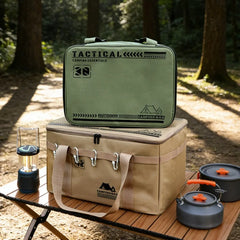
Camp Kitchen Box vs. Pelican Case or YETI GoBox: Can a Hard Case Be Your Kitchen?

Walk through any campground with a lot of overlanders and you'll see it: the old plywood chuck box is gone, and in its place sits a $250 YETI® GoBox or a Pelican® case full of pots and spatulas. It's a smart move for storage. The real question is whether a hard case can actually be your kitchen — or whether it's just a very good box to keep a kitchen in.
Why Campers Are Swapping Chuck Boxes for Hard Cases
The appeal is easy to understand. A traditional chuck box is heavy, bulky, and made of wood that swells when it gets wet. A premium hard case fixes all three problems at once: it seals out dust and rain, it survives being dropped off a tailgate, and it looks good doing it. In forum threads on river and truck-camping sites, owners describe using a GoBox 30 as a kitchen box for years and keeping it dry through rain, spray, and even a dunk in the river.
If you've already read our camp kitchen vs. chuck box comparison, you know the chuck box lost mostly on weight and weather resistance. Hard cases win both of those fights. So they deserve an honest look — with the specs, not the marketing.
The Contenders: Real Specs Side by Side
Here are the three cases people most often turn into kitchen boxes, next to an all-in-one camp kitchen box. Case specs come from the manufacturers and major retailers; street prices can move a bit.
| Spec | YETI GoBox 30 | YETI GoBox 60 | Pelican 1600 (no foam) | VOZ Camp Kitchen |
|---|---|---|---|---|
| Price | $250 | $300 | About $225–$230 | $1,169 |
| Interior (L × W × H) | 17.7" × 11.8" × 8.7" | 26.8" × 11.7" × 10.8" | 21.5" × 16.5" × 8.0" | Pre-fitted for included gear |
| Exterior | 20.4" × 14.8" × 11.3" | 30.0" × 14.8" × 13.4" | — | 47.6" × 19.3" × 11.4" |
| Empty weight | 12.1 lb | 17.2 lb | 13 lb | About 57 lb, fully loaded |
| Weather sealing | Waterproof, dustproof | Waterproof, dustproof | IP67 (1 m submersion, 30 min) | Weatherproof, dustproof |
| Stove included | No | No | No | Yes (butane) |
| Sink and running water | No | No | No | Yes (2-gal tank, USB faucet) |
Look at the two weight rows carefully: the case numbers are empty. A GoBox 60 loaded with a stove, cookware, fuel and dishes will land in the same range as any other loaded kitchen box. Hard cases don't make gear weigh less; they just protect it better.

The Stove Test: What Actually Fits Inside
Here's where the "hard case as kitchen" idea runs into geometry. One of the most popular camp stoves in America, the Coleman® Classic two-burner, measures about 21" × 13.5" × 5.6" folded. Now check the interiors:
- GoBox 30: 17.7" long inside. The stove is more than 3 inches too long. It does not fit.
- GoBox 60: plenty of length at 26.8", but only 11.7" wide and 10.8" tall inside. The stove's 13.5" depth won't clear either one, flat or on edge. It does not fit.
- Pelican 1600: 21.5" × 16.5" × 8.0" inside. The stove goes in flat with about half an inch to spare in length — and then it takes up most of the floor.
That's why most GoBox kitchen builds you'll see online use the case as a pantry or a utensil box, with the stove riding separately. Overland Bound members who build Pelican kitchens tend to size up to the bigger 1650 so a stove, a folding table and pots fit together — and weight comes up as a real concern in those same threads.
If you go the case route, a folding two-burner with a built-in windscreen, like our 17,000 BTU 2-Burner Propane Camp Stove, is the piece you'll end up carrying next to the box. Measure it against your case's interior before you buy either one.


A Box Is Storage. A Kitchen Is a Workstation.
This is the difference that matters most at 7 PM with hungry people around. A hard case, no matter how good, gives you a sealed space to keep things in. It doesn't give you:
- A counter. The GoBox 30 lid sits about 11 inches off the ground. You can prep on it, bent over, but only when the box is closed — so everything inside is unavailable while you use it.
- A cooking surface. You still need a table or tailgate for the stove, and a hot stove shouldn't sit on a plastic lid.
- Water and a sink. Washing up means a separate jug and a separate basin, set up somewhere else.
- Light. Cooking after dark means a headlamp or a lantern you remembered to pack.
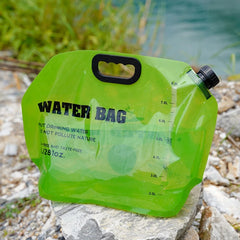
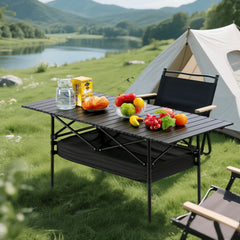
So the honest parts list for a hard-case kitchen is: the case, a stove, a table, a water container, and a wash basin or sink. Using prices from our own catalog as an example, a two-burner stove ($79.95), a roll-up table ($68.95), a 3.4-gallon water container with faucet ($90) and a folding sink with an electric pump ($125) add about $364 to the case. That puts a Pelican 1600 build around $590 and a GoBox 60 build around $664 — before cookware, utensils, or dishes.
That's genuinely cheaper than an all-in-one box, and it's worth saying plainly. What you give up is the thing you can't buy in a case: a single unit that opens into a working kitchen. The sink is the piece most people underestimate, which is why the folding sink is usually the second purchase after the case.


Where Hard Cases Genuinely Win
This isn't a straw man. There are real jobs where a GoBox or Pelican is the better tool:
- River trips and wet boats. An IP67 case is rated for submersion. That's a higher bar than most camp kitchen boxes are built for — we cover what "weatherproof" actually means for a kitchen box in are camp kitchen boxes waterproof.
- Small vehicles. A GoBox 30 is 20.4 inches long. It fits in places a 47-inch kitchen box can't.
- Multi-use owners. In the off-season the same case holds tools, recovery gear or camera equipment.
- Minimal cooking. If dinner is boiling water for a pouch meal, a case plus a small stove is all you need.
One thing hard cases are not is a bear locker. YETI says plainly that the GoBox is not bear-proof on its own, only compatible with add-on locks. In bear country, follow the park's rules: the National Park Service notes that some parks require food lockers or bear-resistant containers, and says never to store food in a pickup bed or strapped to the outside of a vehicle. A latched kitchen box — any brand — goes in the locker or the car when you're not cooking.
What an All-in-One Camp Kitchen Box Does Differently
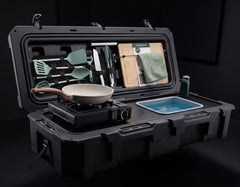
An all-in-one box starts from the opposite direction: instead of a case you fill, it's a kitchen that happens to close into a case. The VOZ Camp Kitchen is our take on that. It's a weatherproof, dustproof food-grade LLDPE case with stainless bar hinges, and inside is a butane stove and frypan, a foldable sink with a USB-rechargeable electric faucet, a removable 2-gallon water tank, a cutting board, a utensil set, and an LED light. You open the lid and you're cooking — the product page puts setup at under 30 seconds.


The trade-offs are real, too. At about 57 lb and 47.6 inches long, it's a two-hand carry and it needs a truck bed, SUV cargo area, or large trunk. It won't go under a raft seat, and it costs more up front than any case build above. What you get for that is fewer separate pieces to buy, pack, unpack, and forget.
FAQ
Can a YETI GoBox hold a full camp kitchen?
It can hold a lot of one. Utensils, spices, a small pot set, plates, and fuel canisters fit well. A standard two-burner camp stove won't fit inside either the GoBox 30 or 60, so plan to carry the stove, table, and water separately.
Which Pelican case is best as a kitchen box?
The 1600 is the smallest common size that fits a classic two-burner stove flat. Many overlanders go up to the 1650 for more room, and that extra room comes with extra weight.
Is a hard case cheaper than an all-in-one camp kitchen?
In dollars, usually yes — roughly $590–$670 for a case, stove, table, water container, and sink using the prices above. You pay for it in setup time and in the number of separate items you carry.
Are GoBox or Pelican cases bear-proof?
Not by default. YETI says the GoBox is only compatible with bear-proof locks. Always follow the specific park's food-storage rules.
The Verdict
A hard case is the best storage box you can put a camp kitchen in. If you raft, drive a small car, or cook simply, a GoBox or Pelican plus a few loose pieces is a smart, cheaper setup. If you cook real meals for a family at the tailgate and you're tired of assembling a stove, a table, a jug, and a basin every night, a hard case solves the wrong problem. It protects your gear. It doesn't give you a kitchen.
- Camp Kitchen vs. Chuck Box: Complete 2026 Comparison Guide
- Camp Kitchen Box vs. Plastic Storage Bins: Is the Upgrade Worth It?
- All-in-One Camp Kitchen Box vs. Building a Setup Piece by Piece
- Camp Kitchen Box vs. Front Runner Wolf Pack Pro: One Box or a Stack of Boxes?
- Will Your Camp Stove Fit? Camp Kitchen Box Stove Dimensions and Compatibility
Ready to upgrade your camp kitchen?
The VOZ Camp Kitchen includes everything you need in one weatherproof case. Sets up in 15 seconds.
Shop VOZ Camp Kitchen →

