

Camp Kitchen for River Rafting and Canoe Trips: Kitchen Boxes, Wash Stations, and Keeping It Dry

A river kitchen has one job a car-camping kitchen never faces: it has to survive the boat. Here is how a portable camp kitchen box fits a raft, a drift boat, or a canoe base camp, where it does not belong at all, and how it slots into the strainer-and-bucket wash routine that river permits actually require.
Where a camp kitchen box fits on the water (and where it doesn't)
Start with the honest version. A camp kitchen box earns its spot where the boat carries the weight and you unload once per camp: oar-rig rafts, catarafts, drift boats, and canoe base camps. It does not belong on portage trips, in kayaks, or in a packraft. If every pound crosses a rocky trail between lakes, leave the box in the truck and bring a barrel and a single-burner stove.
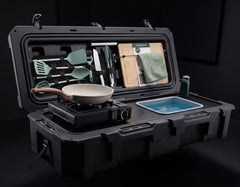
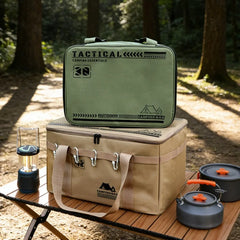
The numbers explain why. The VOZ Camp Kitchen closes to 47.6 by 19.3 by 11.4 inches and weighs about 57 pounds loaded with its butane stove, collapsible sink, USB-rechargeable faucet, 2-gallon tank, and 30-plus items. A tandem tripping canoe like the Old Town Discovery 169 is rated to carry 1,400 pounds, so on flat water the box is a rounding error. On a portage it is a 57-pound object with no shoulder straps. On a 14-foot raft with a 6-foot-6-inch beam, the case is longer than the 37-inch center compartment between the frame rails, so it rides across the tubes on a rear deck or drop floor rather than in a bay. Plan the rig around that before launch day.


If you are still choosing a box, our best camp kitchen setup guide covers the features that matter most. For river use, the two that matter above all others are a hard weatherproof shell and a sink that works without a hose.
Kitchen box vs. river dry box, and how to rig each one
River outfitters solved kitchen storage decades ago with the aluminum dry box: a welded, gasketed can sized to drop into a raft frame bay. Standard widths run 36, 40, and 44 inches, at 13 or 15.5 inches front to back and roughly 15 to 16.5 inches tall; measure the inside of the bay and subtract an inch or two. A purpose-built kitchen dry box, a 15 by 15 by 40 inch aluminum model with legs stored inside and a lid that becomes the counter, sells for around $893 and holds its seal through a flip.
A camp kitchen box is a different tool. The VOZ case is food-grade LLDPE, rated weatherproof, dustproof, and UV-resistant, so it shrugs off rain, spray, and a wet deck. It is not a submersible dry box, and no honest brand would call it one. Where the two overlap is everything after the boats are tied off: the kitchen box opens into a cook and wash station in about 15 seconds, while a dry box still needs a table, stove, buckets, and sink hauled separately.

| Trip | Primary kitchen storage | Where the camp kitchen box fits |
|---|---|---|
| Multi-day whitewater, real flip risk | Aluminum dry box in the frame bay | Stays home, or rides a support raft as the cook station |
| Class I-II float, drift boat, cataraft base camp | Camp kitchen box strapped to the deck | Full kitchen: stove, sink, faucet, counter, utensils in one carry |
| Canoe base camp on a lake or slow river | Camp kitchen box in the center of the hull | Full kitchen at camp; paddle in once, set up once |
| Portage or lake-to-lake canoe trip | Barrel or portage pack | Does not fit; too heavy to carry between lakes |
| Kayak or packraft | Dry bags | Does not fit |
Three rigging rules cover most problems. The box rides low, centered, and latched, with two cam straps crossing the lid to frame D-rings; a 47-inch case spanning the tubes can walk under a single strap in a wave train. The water tank rides empty: at roughly 8 pounds per gallon, a full 2-gallon tank adds about 16 pounds of sloshing weight, so fill it at camp. And the butane cartridges ride in their own dry bag or ammo can, not loose against the cookware.
The river wash station: how the sink fits the four-bucket system
This is where permits get specific. Grand Canyon National Park's noncommercial river regulations recommend a four-bucket dish system set up below the high water mark: a hot soapy pre-wash, a hot soapy wash at 120°F to 140°F, a hot rinse, and a chlorine sanitize at 50 to 100 ppm for 60 seconds. Tarps are required under the kitchen and the dishwashing setup so no food scraps reach the beach. Liquid garbage is strained through a rigid fine-mesh screen, and the solids go in the trash bags.
A camp kitchen sink slots into that system as the scrape-and-pre-rinse station. Plates get scraped into the trash, rinsed under the USB faucet, and only then go into the buckets, so the wash and sanitize water stay clean far longer. The sink is also the hand-wash station, which the same regulations put first on their food-safety list: wash hands with soap and water after handling raw meat and before touching utensils.

Where the strained water goes depends on the river, so check the permit rather than assume:
- Grand Canyon (NPS): strained liquid waste goes directly into the river; dishwashing happens in the wet sand below the high water mark.
- Middle Fork of the Salmon (USFS): a mesh strainer fine enough to catch coffee grounds is required gear; strained dishwater gets tossed over a broad area above the high-water mark, and all waste and ashes are packed out within the quarter-mile river corridor.
- Boundary Waters (USFS): wash dishes at least 200 feet from lakes and streams; every soap counts as pollution, even biodegradable ones.
Our guide to where to dump camp kitchen sink graywater covers the Leave No Trace logic behind those three different answers; the three-bin sink method is the same routine with one fewer bucket.
Water: filling a 2-gallon tank from a silty river
A kitchen faucet is only as good as the water in the tank. On clear rivers you fill the removable 2-gallon tank from a filtered jug and go. On a silty desert river, the Grand Canyon regulations describe the fix for dishwater: settle river water in a bucket with about 2 tablespoons of alum per 5 gallons, then decant the clear water off the top. That settled water is fine for the pre-rinse and hand-washing. Drinking water is a separate system, always, carried in dedicated jugs or run through a filter rated for the job.
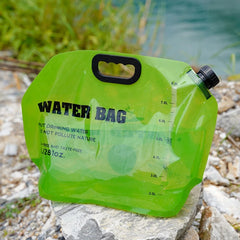
The removable tank earns its keep here: lift it out, carry it to the settling bucket, fill, and drop it back in. A folding water bag with a tap or a 3.4-gallon container with a faucet doubles as the settling vessel and the hand-wash station.


Fire pans, stoves, and the summer stove-only season
Every permitted river treats fire differently. A butane cassette stove handles the cooking on most trips, but the fire-pan gear still rides along because the permit says so:
| River | Fire rule (from the managing agency) |
|---|---|
| Colorado River, Grand Canyon (NPS) | Wood fires only in a metal fire pan of 300 square inches with a 3-inch lip, elevated on manufactured legs, over a fire blanket about 60 by 72 inches; all ash carried out |
| Middle Fork Salmon (USFS) | Metal fire pan of at least 144 square inches with 3-inch sides, fire blanket, and a sealable ash container required even if you never light a fire; a shovel and bucket ride along too |
| Rogue River wild section (BLM) | Raised fire pans and toilet systems required year-round; any open fire within 400 feet of the river goes in a fire pan; each group carries a shovel and a bucket of at least 1 gallon; ashes and charcoal hauled out |
| Lower Deschutes (BLM) | June 1 through October 15: no open fire, charcoal, or portable propane fire pits; only commercially manufactured metal camp stoves and shielded lanterns fueled with propane or liquid fuel |
Read that last row carefully if you run a butane cassette stove. The Deschutes rule names propane or liquid fuel, so call the BLM office before counting on a cassette burner in the restriction season, or pack a small propane stove as backup. Our guide to camp kitchen stove rules during a fire ban walks through restriction stages in more detail.


Canoe base camps: the box goes in the hull, not over the portage
A canoe base camp is the underrated use case: paddle a tandem canoe to a shoreline site, unload once, and cook there all weekend. In a 16-foot-9-inch Discovery 169, a 91-pound hull rated for 1,400 pounds, a 57-pound kitchen box sits flat on the floor just behind the center thwart, with the cooler forward of it to trim the bow.
The rules shift with the venue. In the Boundary Waters, the Forest Service allows nine people and four watercraft per group, fires only in the steel fire grates at designated sites, and no cans or glass bottles at all, with exceptions only for fuel, insect repellent, and medicines. The federal rule behind that ban, 36 CFR 261.57, exempts non-burnable containers designed for repeated use, which is what a kitchen box's spice jars, nesting pots, and tank are. Repackage food into reusable containers, pack the trash out, and the box is legal; the portages still rule it out on any route that leaves the water. Anglers will recognize the routine from our camp kitchen for fishing trips guide: clean the catch at the shoreline, cook it at the box.
FAQ
Will a camp kitchen box survive a raft flip?
Assume no. A weatherproof LLDPE case keeps rain and spray out, but it is not a gasketed dry box, and a full submersion can push water past the latches. Where a flip is a real risk, the aluminum dry box is the primary kitchen storage.
Can the built-in sink replace the four-bucket system?
No. The sink is the scrape, pre-rinse, and hand-wash station. The permit-required wash, rinse, and sanitize buckets still go on a tarp, and the strainer still catches every food particle before any water leaves camp.
How much does the box weigh on the boat?
About 57 pounds loaded, plus about 16 pounds if the 2-gallon tank rides full. On a raft built for six to eight paddlers or a canoe rated for 1,400 pounds, that is a small share of the payload; on a portage it is the whole problem.
Does a butane stove meet river fire rules?
On most rivers a camp stove is exactly what the rules point you toward. The exception is any restriction written around a named fuel, like the Lower Deschutes summer rule. Check the current order for your launch date.
- Best Camp Kitchen in 2026: What to Look for Before You Buy
- Camp Kitchen for Fishing Trips: Clean, Chill, and Cook Your Catch
- Where to Dump Camp Kitchen Sink Graywater (Leave No Trace, Done Right)
- Are Camp Kitchen Boxes Waterproof? What Actually Happens When It Rains
- Beach Camping Camp Kitchen: A Cooking Setup That Beats Sand and Wind
Ready to upgrade your camp kitchen?
The VOZ Camp Kitchen includes everything you need in one weatherproof case. Sets up in 15 seconds.
Shop VOZ Camp Kitchen →

